Download
1 / 10
100 likes | 233 Views
This document outlines the crucial methodologies for modeling hurricane surge impacts along the Hawaiian coastline, with a focus on preparing for and responding to disasters. It emphasizes the importance of understanding storm surge dynamics, including the effects of Earth's rotation, atmospheric pressure changes, and oceanic factors. Various numerical schemes, including 1D, 2D, and 3D models, are examined, alongside specialized tools such as ADCIRC, SLOSH, and FEMA's TTSURGE model. The goal is to minimize loss of life and property through effective storm surge prediction and response.

E N D
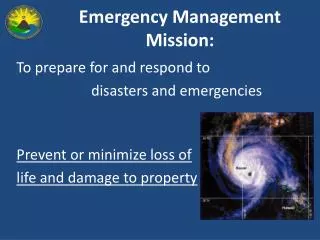
Emergency Management Mission: To prepare for and respond to disasters and emergencies Prevent or minimize loss of life and damage to property
Functional Needs and Requirements: Degree of storm surge flooding coincident with the arrival of a hurricane around the Hawaiian coastline.
The Problem: The cumulative hurricane surge must include: • The combined effects of the earth’s rotation. • The changing atmospheric pressures. • The ocean surface/wind coupling. • The bottom frictional effects.
How do we Model? Numerical schemes: • Quasi-one dimensional • Two dimensional • Three-dimensional
Not an Easy Task: • Storm intensity, size, path, duration over water. • Atmospheric pressure variation. • Speed of translation. • Bathymetry of the offshore region. • Astronomical tides. • Initial water rise, surface waves, and associated wave setup and run up due to wind frictional effects.
Other Models • ADCIRC Coastal Circulation and Storm Surge Model • NOAAA’s Vertical Datum Transformation (VDatum) Tool • NOAA WAVEWATCH III • Coastal Field Data Collection - CFDC • Special Program to List Amplitudes of Surges from Hurricanes—SPLASH • FEMA TTSURGE model • SLOSH – Sea, Lake, and Overland Surges from Hurricanes • MIKE 21 – 2D Modeling System for Floodplains • Storm surge modeling system (SSMS) and Curvilinear-grid Hydrodynamics in 3D (CH3D)-SSMS
Emergency Management Mission: To prepare for and respond to disasters and emergencies Prevent or minimize loss of life and damage to property