Download
1 / 16
160 likes | 283 Views
This paper explores the relationship between innovation and productivity within the service sector, using a structured model that considers various data characteristics. It analyzes the contributions of innovative services to GDP and draws insights from both national accounts and European studies, providing a detailed examination of innovation activities. The findings highlight the significance of endogeneity and instrument selection in economic analyses, while paving the way for future research to enhance model specifications and include additional countries in the assessment of innovative service industries.

E N D
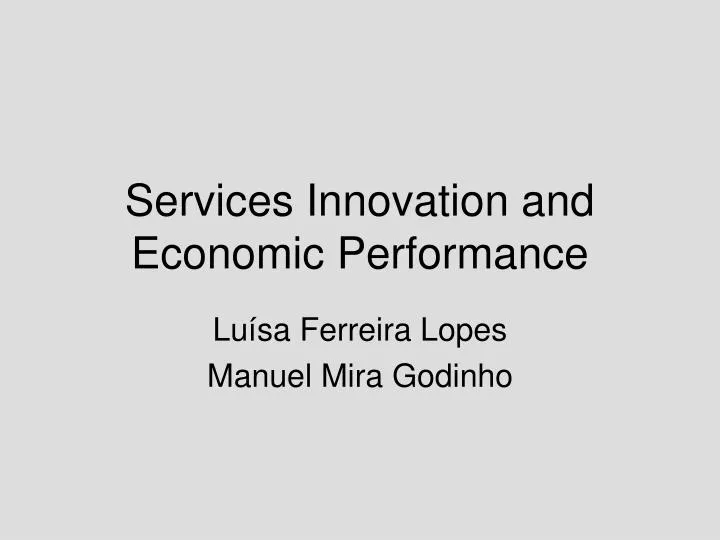
Services Innovation and Economic Performance Luísa Ferreira Lopes Manuel Mira Godinho
Services Contribution to GDP Source: National Accounts, OECD
CIS2 – Results for PortugalInnovation in Services Source: Conceição & Ávila, 2001
CIS2 – Results for Europe% Innovative Firms in Services Source: Conceição & Ávila, 2001
What is new ? • The analyses of the innovation-productivity relationship in the services context • With a structural model • Considering the characteristics of the data • Compare previous quantitative services studies
Limitations • Pure cross-section • Proxis for labor productivity and innovation output
Any conclusions, so far? ...... • Endogeneity is a major problem • The choice of instruments is critical for the results • The model is highly sensitive to different estimation methods
Developments • Further tests to determine the best specification and estimation method • Test for structural changes in the model • Extend the model and consider other countries – SIEPI database • Use a value added measure for productivity • Combine CIS3 survey with CIS2 to build a panel data set