The Nervous System
This overview delves into the intricate workings of the nervous and endocrine systems. The nervous system comprises the central nervous system (brain and spinal cord) and the peripheral nervous system, including somatic and autonomic functions. Key roles of the autonomic system are highlighted, distinguishing between sympathetic and parasympathetic responses. Additionally, the endocrine system's communication via hormones is explored, focusing on critical glands such as the pituitary, thyroid, adrenal, and sex glands, and their impact on growth, metabolism, and emotions.

The Nervous System
E N D
Presentation Transcript
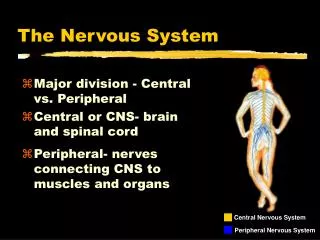
The Nervous System 2 N.S. structures (p.156) : Peripheral Nervous System – Nerve endings branched out among the extremities Central Nervous System – brain and spinal cord
The Nervous System 2 Major parts of peripheral (158): Somatic - Voluntary actions Autonomic - involuntary (heartbeat, stomach, etc.) What about breathing & blinking?
The Nervous System Autonomic parts A. Sympathetic - prepares for emergencies: blood pressure , digestion stops, etc.
The Nervous System Autonomic parts B) Parasympathetic - conserve energy & recover (drop in b.p., etc.)
The Nervous System 2 important parts of the Central: A. Spinal Cord (neurons) B. Brain
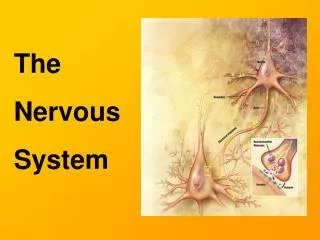
The Nervous System: Micro From BODY to BRAIN…and back- (crosses at a synapse) Neurons: long, thin cells that transmit data within the body Neuron message transmission is a combination of - electrical and chemical
The Nervous System: Micro Neuron parts include (label): *Dendrites *Axons (myelin) *cell body *nucleus *synapses *Axon terminals
Dendrites *bring info. TO the cell body *many dendrites / cell *branch NEAR the cell body
Axons *take info. AWAY FROM the cell body *usually few (or one) axon / cell *branch further from cell body *release neurotransmitters
How the Nervous System Works Nerve impulses -electrical within (the neuron) -chemical across (the synapse)
Endocrine System • Sends messages to the body using Hormones Through the Bloodstream
Endocrine System Pituitary Gland -Under the direction of the Hypothalamus -”master gland” that regulates other endocrine glands -regulates growth and metabolism
Endocrine System Thyroid • produces thyroxine • too little = lazy and lethargic (hypothyroidism) - too much = overactive: loss of weight & sleep (hyperthyroidism)
Endocrine System Adrenal Glands - active when angry or frightened - release epinephrine (adrenaline) & norepinephrine (noradrenaline) • can influence emotions (fear & anxiety) • Steroid release helps w/ energy when needed
Endocrine System Sex Glands • testes: sperm & testosterone • ovaries: eggs, estrogen & progesterone • Affect physical & sexual development
Hormones vs Neurotransmitters slow, widespread messages between cells bloodstream rapid, specific messages
The Nervous System 2 N.S. structures (p.156) : Peripheral Nervous System – Central Nervous System –
The Nervous System 2 Major parts of peripheral (158): Somatic - Autonomic -
The Nervous System Autonomic parts A. Sympathetic -
The Nervous System Autonomic parts B) Parasympathetic -
The Nervous System 2 important parts of the Central: A. Spinal Cord (neurons) B. Brain
The Nervous System: Micro From BODY to BRAIN…and back- Neurons: Neuron message transmission is a combination of -
The Nervous System: Micro Neuron parts include (label):
Dendrites * * *
Axons * * * *
How the Nervous System Works Nerve impulses within (the neuron) across (the synapse)
Endocrine System • Sends messages to the body using Through
Endocrine System Pituitary Gland - - -
Endocrine System Thyroid -
Endocrine System Adrenal Glands - - -
Endocrine System Sex Glands
Hormones vs Neurotransmitters * * * *