Understanding Couples in Mechanical Systems
Learn about couples in mechanics, how they create rotational effects and moments, and their impact on rigid bodies. Discover the equilibrium conditions and mechanical equivalence of force pairs.

Understanding Couples in Mechanical Systems
E N D
Presentation Transcript
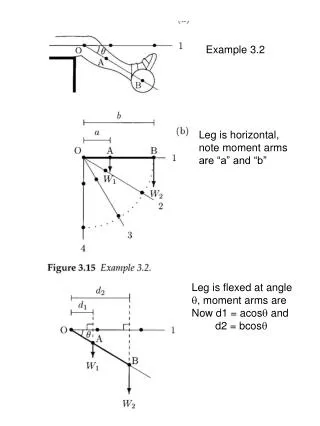
Example 3.2 Leg is horizontal, note moment arms are “a” and “b” Leg is flexed at angle , moment arms are Now d1 = acos and d2 = bcos
A couple is formed by two parallel forces with equal magnitude and opposite directions. On a rigid body a couple causes rotation and the rotational effect is called a couple-moment. M = F (d-b) + F b = F d is the moment about C which means that the couple has the same moment about any point in space lying between points A and B.
No effect of these forces and no moments as well since they cancel. These two now form a couple and a CCW moment equal to M=Fd All of these figures are mechanically equivalent. Overall effect of a pair of forces applied to a rigid body is zero if the forces have an equal magnitude and same line of action but act in opposite directions.
The moment of a force about a point is the vector product of the position and the force vectors. F = Fx i + Fy j r = rx i + ry j
So when we do the needed operations we get for The moment that: M = ( rx Fy – ry Fx ) k