Dynamic Memory
This guide explores the differences between static and dynamic memory allocation in C++. Static memory is allocated and deallocated implicitly during compile-time (e.g., `int x; double y[100];`). In contrast, dynamic memory is allocated during runtime using `new` and deallocated with `delete`. Examples illustrate dynamic arrays, 2D matrices, and how to handle memory properly, including allocating memory for lists of names. Exercises are provided for practicing dynamic memory techniques, including sorting and finding min/max values.

Dynamic Memory
E N D
Presentation Transcript
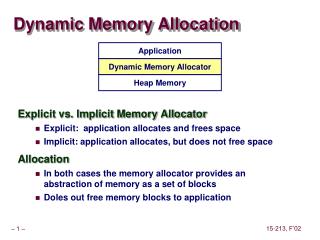
Static v.s. dynamic memory • Stataic memory, for example: int x; double y[100]; is allocated and de allocated implicitly. • Dynamic memory is allocated and de allocated during execution explicitly using new and delete statements.
new statement The new statement is used to allocate memory during run-time. Example: int *p; p=new int; // returns the address of allocated 2 bytes. If // memory could not be allocated NULL is // returned. cin>>*p; cout>>*p;
Example double * B=new double[20]; // B is a dynamic array of 20 // double elements. B points to //the first element. int N; int *A; cin>>N; A=new int[N]; // A is a dynamic array of N integers
delete statement • The delete statement is used to de allocate memory reserved during run-time using new statement. • Example: char *p=new char; cin>>*p; … delete p;
Example int *a; a=new int[10]; for (int i=0; i<=9; i++) cin>>a[i]; // cin>>*(a+i); … delete a; // deletes only a[0] delete [ ] a;// deletes the 10 elements
Example: dynamic array to store a string char *s; s=new char[20]; cin>>s; cout<<s; cin>>*s; cin>>*(s+1); cout<<s[3];
Example: a list of 20 names each of which stored in a dynamic array char *A[20]; for(i=0; i<=19; i++){ cin>>A[i]; // error A[i]=new char[40]; cin>>A[i]; cout>>A[i]; } … for(i=0; i<=19; i++) delete [ ]A[i];
Example: a list of N names each of which stored in a dynamic array char **A; int N; cin>>N; A=new char*A[N]; for(i=0; i<=N-1; i++){ A[i]=new char[40]; cin>>A[i]; } … for(i=0; i<=N-1; i++) delete [ ]A[i];
Example: 10x10 dynamic matrix of integers int * a[10]; for(i=0;i<=9;i++) a[i]=new int[10];
Example: mxn dynamic matrix of integers int **b; int m,n; cin>>m>>n; b=new int *[m]; for(i=0;i<=m-1;i++) b[i]=new int[n]; … //read values for(i=0;i<=m-1;i++) for(i=0;i<=n-1;i++) cin>>b[i][j]; //cin>>*(*(b+i)+j); //delete dynamic memory for(int i=0; i<=m;i++) delete [ ]b[i]; delete[ ]b;
Example: dynamic array of dynamic strings char **b; char s[80]; int m;//number of strings cin>>m; b=new char*[m]; for(int i=0; i<m; i++){ cin>>s; b[i]=new char[strlen(s)+1]; strcpy(b[i],s); }
Exercize • Write a function that takes an array called X of N integers and returns a pointer to a new array that has the original vales of X stored in ascending order. Do not change the values of X. • Redo using pass by reference.
Exercize • Write a function to find the min and max in a matrix and store the results in a dynamic one-dimensional array of 2 elements and return the address of the dynamic memory. • Redo using pass by reference.
Exercize • Write a function to count and store the even values in an array in a dynamic array and returns the address of this array. • Redo using pass by reference.