Distance and Equations in Coordinate Geometry
320 likes | 336 Views
Learn how to calculate distance between two points using the Pythagorean theorem and explore equations of straight lines. Understand the concept of parallel lines.


Distance and Equations in Coordinate Geometry
E N D
Presentation Transcript
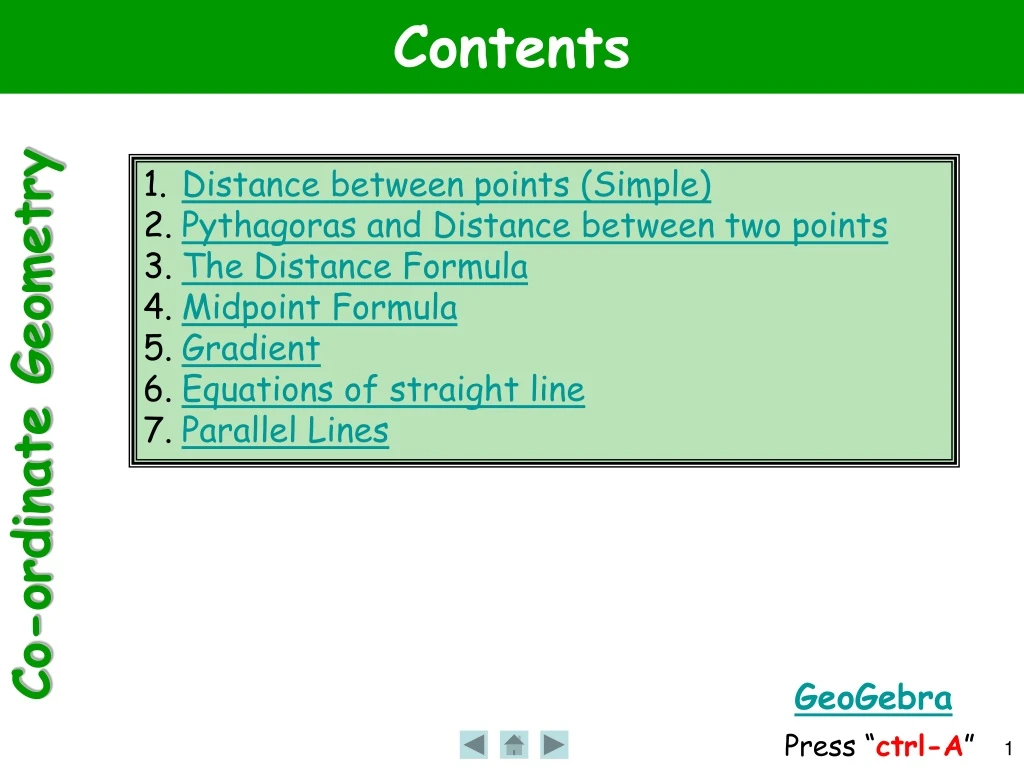
Contents • Distance between points (Simple) • Pythagoras and Distance between two points • The Distance Formula • Midpoint Formula • Gradient • Equations of straight line • Parallel Lines GeoGebra Press “ctrl-A”
7 6 5 4 3 2 1 0 3 4 -1 2 5 6 8 9 10 11 12 13 14 15 1 7 -1 -2 -3 10.1 Distance between Two Points (1/5) = 7 to (7,3) Distance from (0,3)
7 6 5 4 3 2 1 0 3 4 -1 2 5 6 8 9 10 11 12 13 14 15 1 7 -1 -2 -3 10.1 Distance between Two Points (2/5) = 6 to (7,3) Distance from (7,-3)
7 6 5 4 3 2 1 0 3 4 -1 2 5 6 8 9 10 11 12 13 14 15 1 7 -1 -2 -3 10.1 Distance between Two Points (3/5) = 5 to (7,5) Distance from (2,5)
7 6 5 4 3 2 1 0 3 4 -1 2 5 6 8 9 10 11 12 13 14 15 1 7 -1 -2 -3 10.1 Distance between Two Points (4/5) = 5 to (13,2) Distance from (13,7)
7 6 5 4 3 2 1 0 3 4 -1 2 5 6 8 9 10 11 12 13 14 15 1 7 -1 -2 -3 10.1 Distance between Two Points (5/5) = 9 to (12,-2) Distance from (3,-2)
7 6 5 4 3 2 1 0 3 4 -1 2 5 6 8 1 7 -1 -2 -3 10.1 Distance – Pythagoras (1/3) c2 = a2 + b2 c2 = 32 + 42 4 c2 = 9 + 16 3 c2 = 25 c= 5 = 5 to (4,5) Distance from (1,1) GeoGebra
7 6 5 4 3 2 1 0 3 4 -1 2 5 6 8 1 7 -1 -2 -3 10.1 Distance – Pythagoras (2/3) c2 = a2 + b2 4 c2 = 52 + 42 c2 = 25 + 16 5 c2 = 41 c= 41 = 41 to (7,6) Distance from (2,2)
7 6 5 4 3 2 1 0 3 4 -1 2 5 6 8 1 7 -1 -2 -3 10.1 Distance – Pythagoras (3/3) c2 = a2 + b2 c2 = 62 + 72 c2 = 36 + 49 7 c2 = 85 c= 85 6 = 85 to (5,5) Distance from (-1,-2)
7 6 5 4 3 2 1 0 3 4 -1 2 5 6 8 1 7 -1 -2 -3 10.1 Distance – Pythagoras (1/1) c2 = a2 + b2 c2 = 62 + 92 9 c2 = 36 + 81 c2 = 117 c= 10.81665 6 c≈ 10.8 to (7,7) ≈ 10.8 Distance from (1,-2)
10.2 Distance Formula (1/3) d = (x2-x1)2+(y2-y1)2 7 (x2,y2) 6 (7,5) = (7 - 3)2+(5 --2)2 5 4 = 42 + 72 3 2 = 16+ 49 1 0 (as surd) Exact 3 4 -1 2 5 6 8 1 7 = 65 -1 -2 (3,-2) (approx) ≈ 8.06 (x1,y1) -3 to (7,5)? Distance from (3,-2) GeoGebra
10.2 Distance Formula (2/3) (x1,y1) (x2,y2) to (4,5)? Distance from (12,2) d = (x2-x1)2+(y2-y1)2 = (4 - 12)2+(5 -2)2 = (-8)2 + 32 = 64+ 9 (as surd) Exact = 73
10.2 Distance Formula (3/3) (x1,y1) (x2,y2) to (7,5)? Distance from (6,2) d = (x2-x1)2+(y2-y1)2 = (7 - 6)2+(5 -2)2 = 12 + 32 = 1+ 9 (2 decimal places) Approximate = 3.16 = 10
10.3 Midpoint Formula (1/2) (x2,y2) 7 , (7,6) ( ) 6 x1+x2 2 y1+y2 2 M = 5 Midpoint M. 4 , 3 ( ) 3+7 2 -2+6 2 = 2 1 0 3 4 -1 2 5 6 8 1 7 = (5, 2) -1 -2 (3,-2) (x1,y1) -3 to (7,6)? Midpoint of (3,-2) GeoGebra
10.3 Midpoint Formula (2/2) (x1,y1) (x2,y2) to (4,5)? Midpoint of (12,2) , ( ) x1+x2 2 y1+y2 2 M = , ( ) 12+4 2 2+5 2 = = (8, 3.5)
10.4 Gradient (1/5) Vertical Rise 7 6 5 4 3 2 1 1 2 3 4 5 6 Gradient is the rate of change. Gradient = Horizontal Run (5,7) rise run m = m 4 7-3 5-1 4 4 4 = (1,3) = 1 GeoGebra
10.4 Gradient (2/5) 7 6 5 4 3 2 1 1 2 3 4 5 6 rise run (1,7) m = 6 -4 = 6 7-1 3 -2 (5,1) = -4 1-5 -3 2 = Wolfram Demo
10.4 Gradient (3/5) Gradientscan be: Positive An Increasing function Zero Horizontal Negative A Decreasing function
10.4 Gradient Formula (4/5) 7 6 5 4 3 2 1 1 2 3 4 5 6 y (x2,y2) rise run m = y2-y1 y2-y1 = x2-x1 x2-x1 (x1,y1) y
10.4 Gradient Formula (5/5) (x1,y1) (x2,y2) to (8,10)? Gradient of (4,2) y2-y1 10-2 8 4 m = = = = 2 x2-x1 8-4 (x1,y1) (x2,y2) to (7,3)? Gradient of (5,9) y2-y1 3-9 -6 2 m = = = = -3 x2-x1 7-5
10.5 Linear Equations Two types of equation. 1. Gradient-Intercept Form y = mx +b Gradient y-Intercept 2. General Form ax +by + c = 0 ‘b’ NOT y-intercept ‘a’ always positive. Always ‘0’ We must be able to convert between forms.
10.5 Linear Equations (1/6) Write in General Form a) y = 2x + 3 b) 2y = x +7 -y -y -2y -2y 0 = 2x – y + 3 0 = x – 2y +7 2x –y +3 = 0 x – 2y +7 = 0 x 3 x3 d) y = +3 c) y = -x + 6 x3 +x -6 +x -6 x3 x + y - 6 = 0 3y = x + 9 -3y -3y 0 = x -3y + 9 x -3y + 9 = 0
10.5 Linear Equations (2/6) Write in Gradient-Intercept Form a) 3y = 9x + 6 b) 5y = 2x + 1 ÷3 ÷3 ÷3 ÷5 ÷5 ÷5 2 5 1 5 y = 3x + 2 y = x + c) y - 2x = 0 d) 3y + x -1 = 0 +1 +1 -x +2x +2x -x y = 2x 3y = -x +1 ÷3 ÷3 ÷3 -1 3 1 3 y = x +
10.5 Linear Equations (3/6) Write the Gradient and Y-Intercept 1 2 a) y = 9x + 6 b) y = x - 1 1 2 m = 9 m = b = 6 b = -1 c) y = 2x d) y = x + 7 m = 2 m = 1 b = 0 b = 7
10.5 Linear Equations (4/6) Write the equation. y = mx + b 2 3 a) m=2 b=1 b) m= b=-5 2 3 y = 2x + 1 y = x - 5 c) m=-4 b=-1 d) m=12 b=7 y = 12x + 7 y = -4x - 1
10.5 Linear Equations (5/6) Write the equation as y=mx+b and state m and b. a) y – 2x = 1 b) 2y = 3x + 7 +2x +2x ÷2 ÷2 ÷2 3 2 7 2 y = 2x + 1 y = x + m = 2 3 2 m = b = 1 7 2 b =
10.5 Linear Equations (6/6) Is the point given on the line? a) y = 2x + 1 (2,5) b) 2y = 3x + 7 (1,4) 5 = 2x2 + 1 2x4 = 3x1 + 7 Yes No 5 = 5 8 = 10 d) y = 5x + 1 (1,5) c)y – 2x = 1 (1,3) 3 - 2x1 = 1 5 = 5x1 + 1 1 = 1 Yes 5 = 6 No
10.6 Parallel Lines (1/5) Are two lines parallel? Do they have the same gradient? m1 = m2 To find out if two lines are parallel put in the form y=mx+b Check to see if coefficients of x are equal. GeoGebra
10.6 Parallel Lines (2/5) Are the two lines parallel? 5x + y - 3 = 0 10x + 2y - 7 = 0 y - 3 = -5x 2y - 7 = -10x y = -5x + 3 2y = -10x + 7 y = -5x + 3.5 m1=-5 m2=-5 They are parallel !
10.6 Parallel Lines (3/5) Are the two lines parallel? 3x + y - 3 = 0 6x + 2y - 3 = 0 y - 3 = -3x 2y - 3 = -6x y = -3x + 3 2y = -6x + 3 y = -2x + 1.5 m1=-2 m2=-3 They are NOT parallel !
10.6 Parallel Lines (4/5) Are the interval and line parallel? 4x + 2y - 6 = 0 (2,3) to (5,9) 2y - 6 = -4x y2 – y1 x2 - x1 m = 4y = -8x + 6 9 – 3 5 - 2 y = -2x + 1.5 = m2=-2 m1=2 They are NOT parallel !
10.6 Parallel Lines (5/5) Are the interval and line parallel? 6x + 3y - 5 = 0 (2,9) to (5,3) 3y - 5 = -6x y2 – y1 x2-x1 m = 4y = -8x + 5 3 – 9 5 - 2 y = -2x + 1.25 = m1=-2 m2=-2 They are parallel !