Download
1 / 62
620 likes | 750 Views
This presentation delves into the investigation of Z'-like di-lepton resonances as a gateway to Beyond the Standard Model (BSM) physics, focusing on early discovery potential at the LHC. We will discuss theoretical frameworks that predict various resonance types, including extended gauge groups and technicolor models. By examining production mechanisms, measurement challenges, and possible decay scenarios, this work aims to illuminate how these resonances could guide future collider experiments and provide insights into new physics phenomena.

E N D
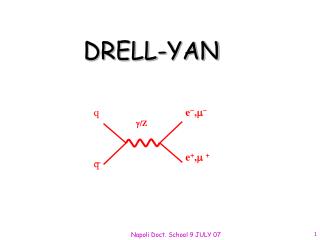
Resonance Signatures(mostly Drell-Yan) G. Azuelos (ATLAS Collaboration) U. Montréal/TRIUMF • Z’-like di-lepton resonances, weak and strong • predicted by numerous models: • extended gauge, technicolor, extra dimensions, Little Higgs, BESS, • W’-like resonances an experimental perspective
Resonances: the source of BSM physics discovery • Theoretical guidance: • what is most interesting • what motivates future collider • Experimental approach: • generic, model-independent • 2-body resonance from any 2 objects possibly described by some theoretical model • Here, will focus on potential early discoveries • leptonic resonances at LHC • top-pair • exclude: • LQ (potential for early LHC results) • 4th family quarks (see talks by E. Kou and S. Sultansoy) • gauge boson resonances (see talk by E. Ozcan) • Higgs, SUSY partners, ... Basic references: - ATLAS CSC notes, arXiv:0901.0512 - CMS, CERN/LHCC 2006-021 - M. Battaglia et al, Physics at CLIC, hep-ph/0412225 - G. Weiglen et al., LHC/ILC interplay, hep-ph/0410364 G. Azuelos - LHC2FC
Z’-like resonances • Extended gauge group? SU(2)LxU(1)Y unnatural? • SU(5), E6, …? • Z’, W’, heavy fermions, Leptoquarks, extended Higgs sector,… • Little Higgs model • 3-3-1 • Extra Dimensions? • Graviton KK resonances • ADD → continuum • RS → narrow resonances • Gauge boson KK resonances • Gauge-Higgs unification, Higgsless models, • fermiophobic Z’ • with bulk localization: flavor-dependent couplings • fermion KK resonances, in particular g*KK • UED • Dynamical EWSB (see WG1 and WG2) • Technicolor • DBESS, • … • more exotic • unparticles, … G. Azuelos - LHC2FC
Z’ resonances: potential early LHC physics Leptonic resonances should be relatively easy and quick to discover, but: • what are they?, in what model do they fit? what are the couplings to fermions and bosons? • what can we measure, and with what precision? • production cross section and decay branching ratios • width • interferences (and interference with Drell-Yan for Z’) • FB asymmetry • rapidity distribution • associated with what other new physics? LHC: a discovery machine ILC: precision measurements SLHC: ultimate (?) window into the unknown mu-collider: new possibilities G. Azuelos - LHC2FC
SSM: Z’ couplings same as those of Z • width ~ 3% of mass, for SSM Z’ • could increase if or if • very little background parton level ~ 2 fb-1 for SSM Z’ Events per 20 GeV Z’ resonance discovery at the LHC - present limits ~ 600 GeV if SM couplings not interesting for 500 GeV ILC, unless couplings are lower than SM - mixing Z-Z’ < 10-3 from LEP EW measurements • relatively clean signal • NLO uncertainties • need good determination of efficiencies, resolution, energy scale (in situ calibration?), charge determination, jet rejection… • luminosity • more difficult to measure DY continuum with precision Langacker, arXiv:0801.1345 Statistics not a problem: ILC helps with precision or investigation of some rare couplings G. Azuelos - LHC2FC
Z’ → mm CMS, CERN/LHCC 2006-021 0.1 fb-1 0.1 fb-1with early misalignment Z’ in very early data Z’ → ee ATLAS, 0.1 fb-1 with misalignments G. Azuelos - LHC2FC
Observables at the LHC resonance shape Z’ rapidity Julien Morel, PhD Thesis ATLAS ang. dist’n at peak FB asymmetry model sensitivity:M Dittmar, A Djouadi, A-S Nicollerat, Phys.Lett. B583 (2004) 111 G. Azuelos - LHC2FC
AFB at the LHC AFB and angular distributions • In a pp collider, we must resort to “guess” that Z’ boost is in direction of quark (by opposition to antiquark) forming it • reliable for large values of boost (rapidity of Z’) • but pseudorapidity cut on leptons: |h| < 2.5 • can correct for dilution to a large extent • efficiency depends only on Y (given incoming type of quarks) because of the symmetry of the detector • some systematic uncertainties (PDF’s…) • note: global lepton reconstruction efficiency depends essentially only on the rapidity of the Z’ for production by a given type of quark flavour, it is independent of the model • at ILC, much better reconstruction: cm kinematics ATLAS Probability to be wrong vs YLedroit et al., hep-ph/0703262 G. Azuelos - LHC2FC
e+e−, m+m−: clean signal, little background (Drell-Yan) • measure s, G, AFB • pileup effects must be understood: effects on resolution, efficiency, purity • is it better to have higher luminosity or higher energy? • t+t−: reconstruction difficult, but possible • measure t polarization and spin correlations • : large QCD background • easier if due to strong interaction resonance Experimental issues at LHC ATLAS - reliance on Monte Carlo:need data and techniques for determination of efficiencies, energy scale, particle mis-ID G. Azuelos - LHC2FC
Discovery reach at the LHC Z’ → ee Julien Morel, Thesis and ATLAS CSC note, arXiv:0901.0512 Present limits: 650-1000 GeV CMS, CERN/LHCC 2006-021 G. Azuelos - LHC2FC
CDDT parametrization M Carena, A. Daleo, B. Dobrescu and T. Tait, PR D70 (2004) 093009 • very general model with 2 Higgs doublets • 15 fermion couplings zf: • couplings to quarks are generation-independent U(1)z charges • anomaly cancellations and possible new fermions must be taken into account • “realistic models” for Tevatron: LEP bounds from contact interactions: G. Azuelos - LHC2FC
B-xLTevatron, 2 fb-1 ATLAS, B-xL, 400 pb-1 Ledroit et al., ATL-PHYS-PUB-2006-024and TeV4LHC: hep-ph/0608322 bounds at Tevatron and early LHC G. Azuelos - LHC2FC
1 ab-1mass assumed measured at LHC Z’ at the ILC At the ILC, sensitivity s from Z’-Z interference - can also be sensitive to high masses (contact-like interaction) LHC/ILC Interplay, G. Weiglein et al, hep-ph/0410364 G. Azuelos - LHC2FC
stats +syst stats sonly di-lepton resonance interpreted as a techni-rho In context of TC Strawman Model (K. Lane) assume M(rT) = M(wT) G. Azuelos - LHC2FC
ATLAS ATLAS Kaluza-Klein gauge resonances • RS model with bulk matter • SM fermions are localized in the extra dimension: their wave functions overlap with the Higgs boson (confined on the TeV-brane) hierarchical patterns of effective 4-D Yukawa couplings. • 3 sets of parameters chosen to suppress FCNC and to be consistent with EW precision measurements F. Ledroit et al., JHEP09(2007)071 G. Azuelos - LHC2FC
Kaluza-Klein Graviton resonances CMS 3 parameters: (2 independent) G. Azuelos - LHC2FC
spin determination ATLAS Also,G* → gg and other channels… region distinguishable from Z’ CMS G. Azuelos - LHC2FC
G*KK at the ILC CLIC G. Azuelos - LHC2FC
The littlestHiggs Model - remarks • the small Higgs mass results from non-exact symmetry pseudoGoldstone boson (pions have mass because quark masses and e.m. break chiral symmetry) • quadratic divergences occur at two-loop level ~ 10 TeV model is not complete UV completion required at ~ 10 TeV • Low energy EW constraints rather severe • FCNC’s at ~ 100 TeV • New particle content G. Azuelos - LHC2FC
low BR Heavy Z, A in LH model WH, ZH, AH arise from [SU(2) U(1)]2 symmetry 2 mixing angles (like qW): q for ZHq’ for AH Measurement of ZHZh and WHWh couplings needed to test model High luminosity/high energy needed! G. Azuelos - LHC2FC
W’→ ln Potential signal in early years of LHC running - transverse mass - ETmiss: need good determination, account for pileup effects, … G. Azuelos - LHC2FC
T. Rizzo, arXiv:0704.0235v2 W’ → n • W’ mass difficult to reconstruct: • only transverse mass observable • AFB not easily measurable (assume light RH neutrino) • n direction unknown • mT is max when cos(q) =0 • can be measured in interference region • possibly also in W’ → t b, with t polarization (b tagging at high lumi?) ATLAS, Physics TDR W’ couplings more easily measurable at ILC, where cm is known, but is there enough mass? (produced in association with W or in pairs) G. Azuelos - LHC2FC
W’ in Little Higgs model 300 fb-1 Need high luminosity/high energy G. Azuelos - LHC2FC
W’ at CLIC CLIC • production cross section high, if above threshold • mass measurement from the threshold • cross section measures the coupling strength G. Azuelos - LHC2FC
Z’, W’ in LRSM ee mm G. Azuelos - LHC2FC
CMS result on WR’ Full GEANT detector simulation and reconstruction 30 fb-1 30 fb-1 1 fb-1 CMS Physics TDR, CERN/LHCC 2006-021 G. Azuelos - LHC2FC
Z’, W’ in LRSM q WR* q N J. Collot, A. FerrariATL-PHYS-98-124, ATL-PHYS-99-034 backgrounds:t tbar DY, WW, ZW, ZZ LRSM bckg: WR,… cuts on mee, pT(jets) FB asymmetry gives a measure of k = gR/gL (merged jets) G. Azuelos - LHC2FC
fraction in + helicity state for WR+ 30 fb-1 fraction in + helicity state for WR- Z’, W’ in LRSM J. Collot, A. FerrariATL-PHYS-98-124, ATL-PHYS-99-018 backgrounds:t tbar DY, WW, ZW, ZZ G. Azuelos - LHC2FC
fermions: D, S, T have charges +5/3, -4/3, -4/3 new vector gauge bosons: vector bi-leptons 3-3-1 model: • explains 3 families: anomalies cancel, taking all 3 generations together • essentially no background, and detection possible up to ~ 1.4 TeV- can measure FB asymmetry, Z’ massB. Dion et al., Phys.Rev. D59 (1999) 075006, B. Brelier and G.A., ATLAS internal note • at ILC, different 331 models can be distinguished (Barreto et al, hep-ph/0703099) G. Azuelos - LHC2FC
ATL-PHYS-2004-025 300 fb1 100 fb1 VBF D-Y 100 fb1M(WR)=650 GeV 100 fb1 100 fb1 300 fb1 300 fb1 Scalar bileptons: doubly-charged Higgs doubly (and singly) charged Higgs in Higgs triplet models (as in LR symmetric model, Little Higgs model, …) G. Azuelos - LHC2FC
Doubly-charged Higgs in Little Higgs Drell-Yan production, with 100% BR into muons discovery limit of 650 GeV with 10 fb-1 CMS, CERN/LHCC 2006-021 G. Azuelos - LHC2FC
3rd family • Possibly different couplings to the 3rd family: • LEP constraints weaker • topcolor • distinguish between scalar (A/H) from vector (Z’) • … but difficult to measure • Z’ → t t : poor resolution in mass reconstruction • method assumes collinear approximation: neutrino in same direction as t, with the t massless 2 x 3-vectors for charged particles, 1 x 2-vector for missing pT → 8 input + 2 constraints for 4 x 3 – 2 = 10 deg. of freedom • works when t’s are not back to back (not too heavy Z’) • good reconstruction at ILC, where s and Pmiss is known ! • Z’ → bb : high QCD background • Z’ → t t : high background from QCD production of top • except if resonance is from a strong interaction process • good for ILC, but limited by mass G. Azuelos - LHC2FC
ATLAS FB Asymmetry(parton level, wrt Z’ direction) further observables for 3rd generation • can measure FB asymmetry wrt to Z’ direction • possibility to measure polarization or spin correlations through decay of t or top • collinear approximation fails for very high mass (back-to-back t’s) parton level GA, B. Brelier, D. Choudhury, PA Delsart, RM Godbole, SD Rindani and RK Singh, Les Houches 2005 G. Azuelos - LHC2FC
For heavy quark production, one diagram dominates: sKK/sSM KK excitation of the gluon UED scenarioD.A. Dicus, C.D. McMullen and S. Nandi, PR D65 (2002) 076007 ATLAS 300 fb-1 March, L; Ros, E; Salvachúa, B; ATL-PHYS-PUB-2006-002 G. Azuelos - LHC2FC
top resonance from bulk RS KK gluon B. Lillie, L. Randall and L-T Wang, hep-ph/0701166 - large overlap of KK gluon and top quark wave functions because both are localized towards TeV brane t-tagging fake rate • can also measure spin correlations (tR coupling?) • experimental issues: • b-tagging • strong collimation of jets from top and from W’s • jet mass can be used, as in: • W. Skiba, D. Tucker-Smith hep-ph/0701247 • - can also have graviton resonance to top pairs (or WW), but higher mass(Agashe et al., hep-ph/0701186) G. Azuelos - LHC2FC
ttbar R Frederix and F Maltoni, arXiv:0712.2355 parton level: must fold in efficiency and energy smearing need precision smearing because cannot distinguish u/d quarks from W decay G. Azuelos - LHC2FC
Jet splitting • Highly boosted di-jet looks like one jet → use algorithm to see if jet splits into two when narrower cone is used jets with pT > 250 GeV Once a jet is found, apply the inclusive kT algorithm to clusters composing it J.M. Butterworth, J.R. Ellis, A.R. Raklev, hep-ph/0702150 G. Azuelos - LHC2FC
di-jet resonances CMS G. Azuelos - LHC2FC
Conclusions • New resonances are potential, early signals of BSM physics • can reach few TeV with first 10 fb-1 • very large QCD backgrounds at LHC • may mask signals • sources of systematic errors difficult to evaluate: • efficiencies, resolutions, energy scale, pileup, • background cross sections • may need higher mass reach higher energy or higher luminosity?? optimization would require detailed MC simulations with realistic detector design • need to understand their origin: LC: precision measurement of resonance parameters cm kinematics G. Azuelos - LHC2FC
from Cvetic and Godfrey, hep-ph/9404216 G. Azuelos - LHC2FC
Narrow Graviton Resonance • Spin determination 100 fb-1 spin-2 could be determined (spin-1 ruled out) with 90% CL up to graviton mass of 1720 GeV G. Azuelos - LHC2FC
ExpectedStatistical precision 100 fb-1 Allanach et al., ATL-PHYS-2002-031 • also G WW , ZZ, jj, mm, tt, hh e.g.:for a resonance observed at mG = 1.5 TeV in ee channelDmG < 10.5 GeV (energy scale error)Ds.B ~ 18%if k/rc = 0.01 (pessimistic) ═› rc =(82±7) x 10-33 m !! G. Azuelos - LHC2FC
2 from LQ - OPAL G. Azuelos - LHC2FC
W+f++W+ Triplet Higgs Single production Main background from WTWT scattering G. Azuelos - LHC2FC
Right-handed interactions? Z’ : first sign of extended gauge group ? • Left-Right Symmetric Model: • right-handed fermions in doublets heavy Majorana nR=N • explains low mass of nL (see-saw mechanism) • WR, ZR associated with right-handed sector • larger GUT groups (includes LRSM) triplet Higgs G. Azuelos - LHC2FC
from Almeida et al., arXiv:hep-ph/0702137v1 G. Azuelos - LHC2FC
triggers EW symm. breaking mass to Z, W, h massless vev for h acquires mass from one-loop gauge interactions 1-loop gauge interactions: t To cancel the top loop,introduce SU(2)L singlet quark TL, and TR The littlestHiggs Model - particles G. Azuelos - LHC2FC