Understanding Weather Fronts and Their Impact on Atmospheric Conditions
300 likes | 419 Views
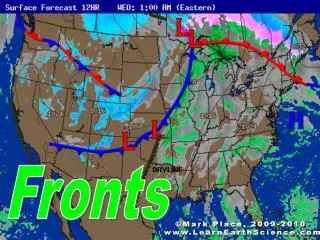
Weather fronts are crucial boundaries where different air masses meet, reflecting varying densities. A front forms when one air mass displaces another, creating distinct weather patterns. Cold fronts occur when a cold air mass overtakes a warm one, often resulting in heavy storms. In contrast, warm fronts see warm air overtaking cooler air, producing extended cloud cover and light precipitation. Stationary fronts lack movement, leading to stagnation in weather conditions. Occluded fronts occur when a cold front catches up with a warm front, leading to unique weather outcomes.


Understanding Weather Fronts and Their Impact on Atmospheric Conditions
E N D
Presentation Transcript
When 2 ____________ air masses meet, density differences usually keep them separate--________________________ • The boundary between air masses is called a_______________
For a front to form, one air mass must __________________________________ • The kind of front depends on ___________ ___________________________________
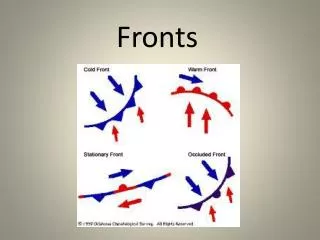
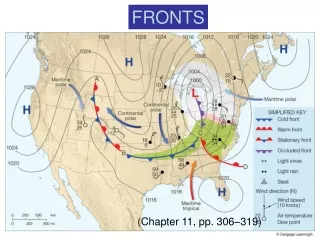
Cold Front • A ____ air mass overtakes a _____ air mass • The moving cold air lifts the warm air • If the warm air is moist, _______________.
A line of heavy storms called a ______________ may occur ahead of a fast-moving cold front
A slow-moving cold front produces ___________________________________
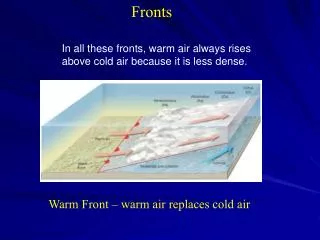
Warm Front • Warm air mass overtakes a cooler air mass • ___________________________________
The slope of a warm front is _________, so clouds may extend far ahead of the front • Warm fronts generally produce __________ _____________________________________
Stationary Front • Two air masses move ____________to the front between them • The front ______________________ • These type of conditions can last for days, producing nothing but Altocumulus clouds. Temperatures remain stagnant and winds are gentle to nil.
Occluded Front • A fast-moving cold front overtakes a slow-moving warm front and ___________________________ ________________________________________ • The cold air comes in contact with cool air beneath the warm air • The warm air is completely cut off, or _________ from the ground • Weather is similar to that produced by a warm front
Wave Cyclones: Low-pressure Storm Centers • Winds blow in ________________ circular paths spiraling upward around the __________________region at the center • ___________________________________ • b/c rising air allows for condensation
Anticyclones: High-pressure Centers • The air sinks and flows ________________ outward from a center of _______________ • Bring _________ weather • Sinking air does not promote cloud formation ***the sinking air could cause a temperature inversion