Download
1 / 52
520 likes | 651 Views
This work explores the intricate phenomena surrounding supernovae, focusing on the neutrino emissions that accompany these massive stellar explosions. We delve into the historical context and evolution of the term "supernova," as well as the spectral and physical classifications such as Type Ia and Type II. By examining simulation studies and observational data—such as those from SN1987A and SN1998aq—we investigate the processes involved in supernova explosions, including accretion mechanisms, energy release, and the role of neutrinos in shaping the resultant stellar remnants.

E N D
Supernova neutrino challenges • Christian Y. Cardall • Oak Ridge National Laboratory • Physics Division • University of Tennessee, Knoxville • Department of Physics and Astronomy • Terascale Supernova Initiative • http://www.phy.utk.edu/tsi
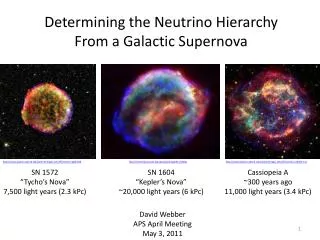
Tycho Brahe, De Nova et Aevi Memoria Prius Visa Stella (1573)
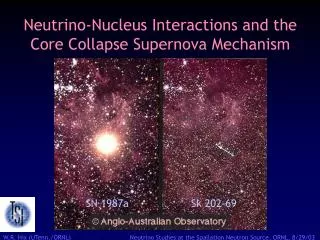
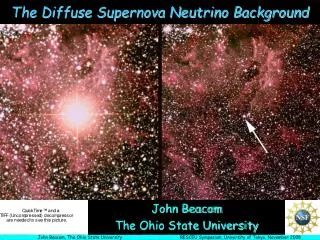
SN 1987A Tarantula Nebula
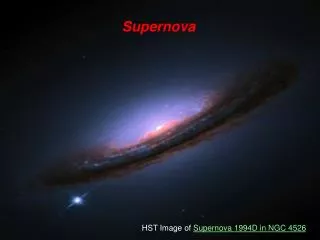
SN 1998aq (in NGC 3982)
The name "supernova" dates from the 1930s. • New stars or "novae" were well known. • The debate about the nature of spiral nebulae led to the realization that there must be • "giant novae" (Lundmark 1920), • novae of "impossibly great absolute magnitudes" (Curtis 1921), • "exceptional novae" (Hubble 1929) • "Hauptnovae" (Baade 1929).
The name "supernova" dates from the 1930s. • The word "supernova" is claimed to have been used by Baade and Zwicky since 1931. LSN/LCN=103
Type Ia (no H, strong Si) Type II (obvious H) Type I (no H) Type Ic (no H, He, Si) Type Ib (no H, obvious He) • Spectral classification of supernovae: Filippenko (1997)
Physical classification of supernovae: • Thermonuclear runaway; • Type Ia, accretion onto a white dwarf.
Physical classification of supernovae: • Core collapse of a massive star; • Type II, outer H layer remains at collapse; • Type Ib, outer H layer stripped before collapse; • Type Ic, outer H and He layers stripped before collapse.
Rotation Magnetic Fields
Burrows and Lattimer 1986 • Neutrino predictions ca. 1986 • Energy release ~ 1053 erg in neutrinos, • Emitted on a time scale of seconds, • With an average neutrino energy of ~10 MeV
Raffelt (1999) SN1987A sent ~1058 “messengers,”with ~two dozen detected • The lucky messengers… Each “event” involves ~109 “messengers,”with at most 1 “detected”
Burrows and Lattimer 1987 • Prediction vs. observation
On the way to explosion… • Accretion continues until stalled shock is reinvigorated: relation between neutron star mass and delay to explosion • Optical display is powered by the decay of 56Ni; connection to neutrino transport • The electron fraction…which determines how much 56Ni is produced is set by neutrino interactions:
Dispersion of elements, electromagnetic display Chandra X-ray Observatory (1999)
The observables to understand include • Explosion (and energy thereof); • Neutrinos; • Remnant properties, • Mass, spin, kick velocity, magnetic fields; • Gravitational waves; • Element abundances; • Measurements across the EM spectrum, • IR, optical, UV, X-ray, gamma-ray;images, light curves, spectra, polarimetry...
Some key ingredients are • Neutrino transport/interactions, • Spatial dimensionality; • Dependence on energy and angles; • Relativity; • Comprehensiveness of interactions; • (Magneto)Hydrodynamics/gravitation, • Dimensionality; • Relativity; • Equation of state/composition, • Dense matter treatments; • Number and evolution of nuclear species; • Diagnostics, • Accounting of lepton number; • Accounting of energy; • Accounting of momentum.
Simulations of collapse and explosion • Spherical symmetry + mixing prescription, simplified neutrino transport Totani, Sato, Dalhed, & Wilson (1998)
Neutrino radiation transport Fluid mixing prescription in the coreboosts neutrino luminosities; notaccepted by most other investigators Magnetohydrodynamics
Simulations of collapse and explosion • Multiple spatial dimensions, simplified neutrino transport Fryer & Warren (2002) Burrows, Hayes, & Fryxell (1995)
Neutrino radiation transport Neutron star mass too small; heating drives explosion too soon. 56Ni mass too small; Ye too low. Magnetohydrodynamics
Simulations of collapse and explosion • Multiple spatial dimensions, simplified neutrino transport Janka & Mueller (1996) Mezzacappa, Calder, Bruenn, Blondin, Guidry, Strayer, & Umar (1998)
Neutrino radiation transport Magnetohydrodynamics
Simulations of collapse and explosion • Spherical symmetry, sophisticated neutrino transport Rampp & Janka (2000)
Simulations of collapse and explosion • Spherical symmetry, sophisticated neutrino transport Thompson, Burrows, & Pinto (2002)
Neutrino radiation transport Magnetohydrodynamics
Simulations of collapse and explosion • Spherical symmetry, sophisticated neutrino transport Liebendoerfer, Mezzacappa, Thielemann, Messer, Hix, & Bruenn (2001)
Neutrino radiation transport Magnetohydrodynamics
Simulations of collapse and explosion • Multiple spatial dimensions, intermediate neutrino transport Janka, Buras, & Rampp (2002)
Neutrino radiation transport Magnetohydrodynamics Neutron star mass and 56Ni mass are reasonable.
...with expertise in all necessary areas... • Radiation transport, • (Magneto-)hydrodynamics, • Nuclear and weak interaction physics, • Computer science, • Large sparse linear systems, • Data management and visualization;
...and support from the U.S. Department of Energy: • Funding through the DOE Office of Sciences' SciDAC program, • Access to DOE's terascale machines (several 1012 bytes of memory and flops), • Access to the expertise of teams specializing in • Advanced solvers, • Advanced computational meshes, • Performance on parallel architectures, • Data management and visualization, • Software interoperability and reusability.
Accretion shock instability • A standing accretion shock, an analytic solution in spherical symmetry, is used as an initial condition. Blondin, Mezzacappa, & DeMarino (2003)
Accretion shock instability • The standing accretion shockis unstable in 2D/3D to thepoint of explosion.
Neutrino radiation transport: a computational challenge • Large dynamic range in time and space • Time scale of neutrino interactions is many orders of magnitude smaller than the fluid time scale • Use implicit time differencing: Evaluate right-hand side at new values of the variables • Gravitational collapse gives a range of spatial scales • Some features need higher resolution, e.g. shock
Neutrino radiation transport: a computational challenge • Dimensionality • 2D: solution vector of several 109 elements • 3D: solution vector approaching 1012 elements
Neutrino radiation transport Magnetohydrodynamics