Miscellaneous punctuation
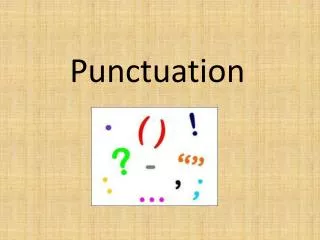
Explore the nuances of various punctuation marks including dashes, parentheses, brackets, and ellipses. Dashes are used to add emphasis or interrupt a sentence; parentheses provide additional, yet de-emphasized, information. Brackets are essential for inserting words into quotations and acknowledging errors. Ellipsis points signify omissions in text. Learn how to apply these punctuation marks effectively to enhance clarity and precision in your writing. Review textbook resources and writing guides for proper usage.

Miscellaneous punctuation
E N D
Presentation Transcript
The Dash • Dashes interrupt a sentence to add information. • Hit the hyphen key twice to create a dash. • The care-takers – those who are helpers, nurturers, teachers, mothers – are still systemically devalued.
The Dash • Review text pages for more examples of when to use the dash in writing.
Parentheses • Parentheses are like dashes, as they set off extra or interrupting words. • Unlike dashes which emphasize words, parentheses de-emphasize what they enclose. • Do not overuse parentheses. • Review text pages if this is unclear.
Brackets • Brackets are used when you need to insert words into quotations. • When there is an error in a source and you want to acknowledge that error as someone else’s, use [sic]. • In Latin, sic means so, thus.
Ellipsis points • Ellipsis means “omission.” Ellipsis points in writing are a series of three spaced dots (period key). • Use ellipsis points when you intentionally omit words or phrases. • See text pages for more discussion.
Slash • It is also known as a virgule or solidus. It is a diagonal line that separates or joins in special circumstances. • Use them to separate lines of poetry, • Use them with fractions, and • Use them with and/or.
When in doubt … • Punctuation can make or break a good written work. • Check your punctuation usage with your textbook and with the packet pages.