Understanding Work and Energy: Principles of Force, Kinetic Energy, and Power
This chapter explores the fundamental concepts of work and energy transfer to objects. It defines energy as the ability to move an object and introduces the work-energy principle, represented by ΣW = ΔK. Various methods to solve work/energy problems are discussed, including calculating net work through the sum of forces and change in kinetic energy. Key formulas for constant and variable forces are provided, alongside definitions of power as the rate of work done over time. Understanding these concepts is essential for further studies in physics.

Understanding Work and Energy: Principles of Force, Kinetic Energy, and Power
E N D
Presentation Transcript
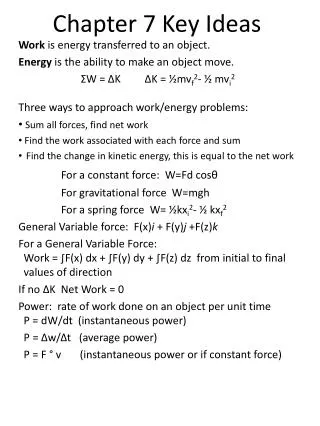
Chapter 7 Key Ideas Work is energy transferred to an object. Energy is the ability to make an object move. ΣW = ΔK ΔK = ½mvf2- ½ mvi2 Three ways to approach work/energy problems: Sum all forces, find net work Find the work associated with each force and sum Find the change in kinetic energy, this is equal to the net work For a constant force: W=Fdcosθ For gravitational force W=mgh For a spring force W= ½kxi2- ½ kxf2 General Variable force: F(x)i + F(y)j +F(z)k For a General Variable Force: Work = ∫F(x) dx + ∫F(y) dy + ∫F(z) dz from initial to final values of direction If no ΔK Net Work = 0 Power: rate of work done on an object per unit time P = dW/dt (instantaneous power) P = Δw/Δt (average power) P = F ° v (instantaneous power or if constant force)