Download
1 / 11
110 likes | 271 Views
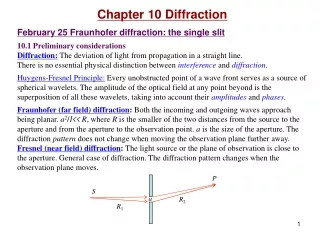
Diffraction occurs when wavefronts pass through a narrow slit, causing them to spread out. This phenomenon depends on the size of the slit relative to the wavelength of the wave. In 1801, Thomas Young demonstrated that light behaved as a wave through his double-slit experiment, which showcased how diffracted waves interfere constructively and destructively, creating distinct patterns of light and dark bands. The extent of diffraction varies with the wavelength of light; longer wavelengths, such as red, diffract more than shorter wavelengths like violet. This principle is evident even in everyday observations, such as patterns seen through narrow openings.

E N D
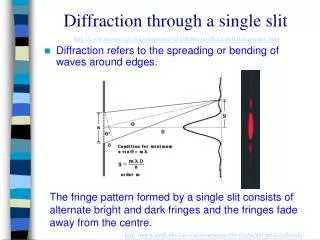
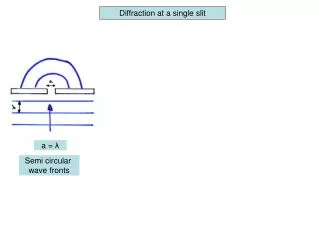
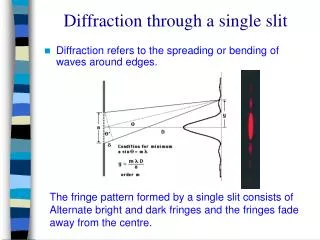
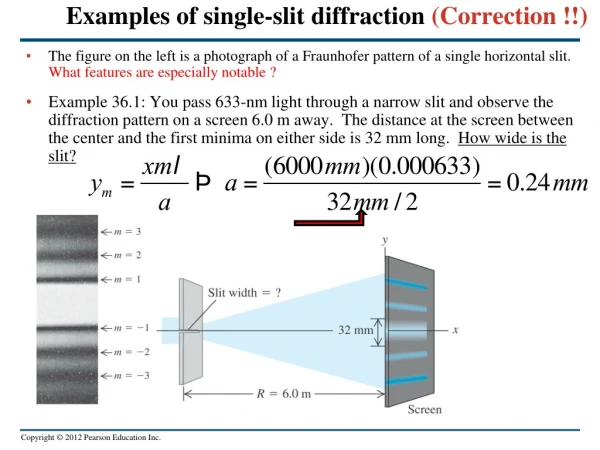
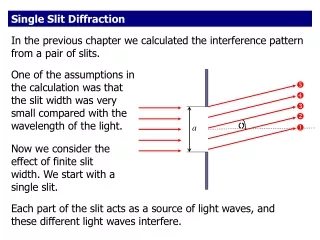
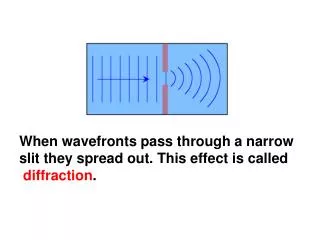
When wavefronts pass through a narrow slit they spread out. This effect is called diffraction.
The amount of diffraction depends upon the size of the slit. If the slit is comparable in size to the wavelength of the wave then maximum diffraction occurs.
The number of slit openings also determines what the diffraction pattern looks like.
Thomas Young, in1801, first established that light was a wave by demonstrating that light diffracted. • He also provided the first measurement of the wavelength of light.
Thomas Young’s Double-Slit Experiment • He allowed sunlight to fall on two slits. • He knew that if light was a wave, it would diffract as it passed through the slits. • The diffracted waves would have areas of both constructive and destructive interference. • This interference would produce bright and dark areas on a screen.
Different frequencies (colors) of lightdiffract by different amounts- the LONGER the wavelength, the more the diffraction!
If the wavelength of light is longer, the pattern on the screen is more spread out. (700 nm- 400 nm) Red light spreads out more than violet. If the screen is farther, the pattern on the screen is more spread out. If the slits are CLOSER to each other, the pattern on the screen is more spread out.
Optical diffraction effects can be seen with eye - in fact most of us when children have noticed it, but ignored it when becoming adults. Look through a narrow slit between your fingers. If you look carefully you should see the objects behind are distorted and that blackish bands parallel to the slit appear in the gap. The bands are diffraction patterns.
In the atmosphere, diffracted light is actually bent around atmospheric particles -- most commonly, the atmospheric particles are tiny water droplets found in clouds. • An optical effect that results from the diffraction of light is the silver lining sometimes found around the edges of clouds