Download
1 / 24
240 likes | 356 Views
This syllabus outlines the course CSE 651, taught by Steve Lai at Ohio State University, focused on the principles and practices of network security. The course covers essential topics from William Stallings' textbook, including symmetric and public-key encryption, cryptographic hash functions, message authentication, and various security mechanisms. Grading is based on assignments, midterms, and a final exam. Prerequisites include mathematical reasoning and completion of CSE 677. Office hours and contact information for the instructor are provided.

E N D
CSE 651:Introduction to Network Security Steve Lai Spring 2010
Syllabus • Instructor: Steve Lai • Office: DL 581 • Office hours: MWF 2:30-3:30 • Email: lai@cse.ohio-state.edu • Home page: www.cse.ohio-state.edu/~lai
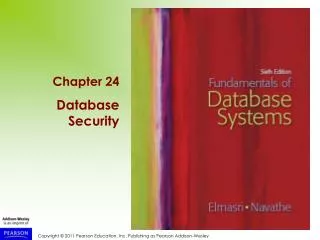
Text (required) • William Stallings Cryptography and Network Security: Principles & Practice (5th edition) Pearson/Prentice Hall, 2010. • http://www.amazon.com/Cryptography-Network-Security-Principles-Practice/dp/0136097049
Prerequisite • CSE 677 • Some maturity in mathematical reasoning
Content of Course • Will cover the first 17 chapters of Stallings with many sections skipped.
Topics • Introduction (Ch. 1) • Symmetric-key encryption • Classical encryption techniques (Ch. 2) • Block ciphers and data encryption standard (Ch. 3) • Advanced encryption standard (Ch. 5) • Block cipher operation (Ch. 6) • Stream ciphers (Ch. 7) • Public-key cryptography and RSA (Ch. 9)
Topics (cont.) • Cryptographic hash functions (Ch. 11) • Message Authentication (Ch. 12) • Digital Signatures (Ch. 13) • Key management and distribution (Ch. 14) • User authentication protocols (Ch. 15) • Web Security: SSL (Ch 16) • IEEE 802.11 Wireless LAN Security (Ch. 17)
Grading plan • Assignments: 20% • Midterm exam I: 25% (Monday, April 26) • Midterm exam II: 25% (Monday, May 17) • Final exam: 30% (Wed, June 9, 9:30) • Late homework will NOT be accepted.
Three related courses • CSE 551: Introduction to Information Security • CSE 652: Applied Information Security Project • CSE 794Q: Introduction to Cryptography
Introduction CSE 651: Introduction to Network Security
What is Network Security? • Network Security – measures to protect data during their transmission over a network or internet. • Internet Security
Aspects of Network Security • ITU-T Recommendation X.800 “Security Architecture for OSI” describes network security in three aspects: • security attack • security service • security mechanism
Security Attack • Attack: any action that compromises the security of information • Many different types of attacks • Can be generally classified as • Passive attacks • Active attacks
Passive Attacks • Reading contents of messages • Also called eavesdropping • Difficult to detect passive attacks • Defense: to prevent their success
Active Attacks • Modification or creation of messages (by attackers) • Four categories: modification of messages, replay, masquerade, denial of service • Easy to detect but difficult to prevent • Defense: detect attacks and recover from damages
Security Services (Goals) • Data Confidentiality: protecting data from unauthorized disclosure. • Data Integrity: • assuring that data received is as sent (w/o modification) • or detecting its non-integrity.
Authentication: • (from dictionary: the action of confirming someone or something as authentic.) • (Peer) entity authentication: When establishing a logical connection, assure that the other party is as claimed. • Data origin authentication: In a connectionless transfer, assure that the source of received data is as claimed.
Message Authentication • Data origin authentication • Data integrity • Entity Identification • Entity authentication
Non-Repudiation: • Origin non-repudiation: preventing sender from denying that he has sent a message • Destination non-repudiation: preventing receiver from denying that she has received a message
Access Control: preventing unauthorized use of a resource. • Availability:making systems or resources available upon demand by legitimate users.
Security Mechanisms • Means to implement security services: • Encryption • Symmetric-key encryption • Public-key encryption • Key management • Hash functions • Message authentication codes • Digital signatures • Entity authentication protocols