The Legacy of Confucius: A Guide to Confucianism
Explore the origins, beliefs, and texts of Confucianism founded by K’ung Fu Tzu in 5th-6th century B.C. Learn about the major principles, practices, and influence of this ancient Chinese philosophy. Discover the positive view of human nature and the significance of benevolence (ren).

The Legacy of Confucius: A Guide to Confucianism
E N D
Presentation Transcript
Confucianism Phil Curtis Garrett Buster
Founded 5th-6th century B.C. • China • Founded by K’ung Fu Tzu (Pronounced Confucius) • Roughly 5-6 million adherents Origin
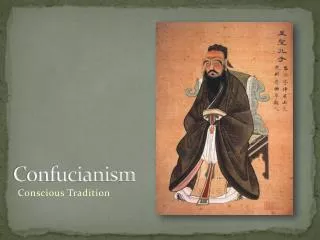
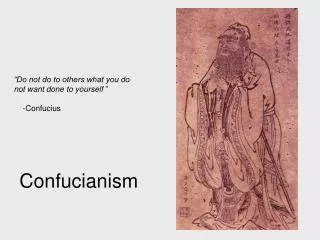
Born in 551 B.C. • Ancestors were members of aristocracy • Father died when he was 3 • Raised by his mother • Held several government positions • Teachers were masters in the six arts K’ung Fu Tzu
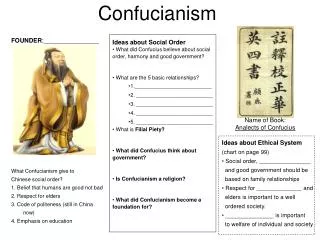
Five Classics • ShuChing (Classic of History) • Shih Ching (Classic of Odes) • I Ching (Classic of Changes) • Ch'unChing(Spring and Autumn Annals) • Li Ching (Classic of Rites) Texts-Confucian Canon
Four Books • Lun Yu (Analects) • Chung Yung (Doctrine of the Mean) • Ta Hsueh (Great Learning) • Meng Tzu (Mencius) Texts-Confucian Canon contd.
Major principle is ren (benevolence) • Highly optimistic view of human nature • Heaven (T’ien) was regarded as a positive force in the universe by Confucious Beliefs
No specific practices • Practices of other religions people follow • Taoism, Buddhism Practices
"Confucianism." ReligionFacts. N.p., 2005. Web. 10 Jan. 2012. • "Confucianism." Patheos. N.p., 2008. Web. 10 Jan. 2012. Sources