Recursion
This post explains recursion and its application through a binary search example. It covers the concept of recursion, direct and indirect recursion, writing recursive functions, activation records, the Fibonacci series, stacks for recursion, and the efficiency of binary search.

Recursion
E N D
Presentation Transcript
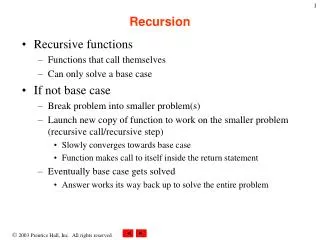
What Is Recursion? • Recursive call • A method call in which the method being called is the same as the one making the call • Direct recursion • Recursion in which a method directly calls itself • Indirect recursion • Recursion in which a chain of two or more method calls returns to the method that originated the chain
Writing a recursive function to find n! • Factorial(n) = n*n-1*n-2*…*1 • Factorial(4) = 4 * 3 * 2 * 1 = 24 • Factorial(0) = 1 • Another definition of Factorial(n) • n*Factorial(n-1) if n>0 • 1 if n=0
Recursive function • Call itself • Fact(0)=1; • Parameter to recursive call is diminished by 1 • Always reach base case if n>=0 int fact(int n) { if (n==0) return 1; return n*fact(n-1); }
Recursion Versus Iteration • Recursion not always ‘necessary’ • Not even allowed in some languages • Any task accomplished with recursion canalso be done without it • Nonrecursive: called iterative, using loops • Recursive • Runs slower, uses more storage • Elegant solution; less coding
Some Definitions • Base case • The case for which the solution can be stated nonrecursively • General (recursive) case • The case for which the solution is expressed in terms of a smaller version of itself • Recursive algorithm • A solution that is expressed in terms of (a) smaller instances of itself and (b) a base case
General format for many recursive functions if (some condition for which answer is known) solution statement //base case else recursive function call //general case
Recursive function • Call itself • Fact(0)=1; • Parameter to recursive call is diminished by 1 • Always reach base case if n>=0 int fact(int n) { if (n==0) return 1; return n*fact(n-1); }
Activation record for Fact(3) Box Method • Activation record • Arguments • Local variables • A place holder for value returned by recursive calls • The return value of the function itself
Three-Question Method of verifying recursive functions • Base-Case Question: Is there a nonrecursive way out of the function? • Smaller-Caller Question:Does each recursive function call involve a smaller case of the original problem leading to the base case? • General-Case Question: Assuming each recursive call works correctly, does the whole function work correctly?
Example Using Recursion: Fibonacci Series • Fibonacci series: 0, 1, 1, 2, 3, 5, 8, 13, 21 … • Each number sum of two previous ones • fib(n) = fib(n-1) + fib(n-2)
Example Using Recursion: Fibonacci Series long fibonacci( long n ) { if ( n == 0 || n == 1 ) return n; else return fibonacci( n - 1 ) + fibonacci( n – 2 ); }
f( 3 ) return f( 2 ) + f( 1 ) return f( 1 ) f( 0 ) return 1 + return 1 return 0 Example Using Recursion: Fibonacci Series
Stacks for Recursion • A stack • Specialized memory structure • Like stack of paper • place new on top • remove when needed from top • Called ‘last-in/first-out’ memory structure • Recursion uses stacks • Each recursive call placed on stack • When one completes, last call is removedfrom stack
Stack Overflow • Size of stack limited • Long chain of recursive calls continuallyadds to stack • All are added before base case causesremovals • If stack attempts to grow beyond limit • Stack overflow error • Infinite recursion always causes this
Binary Search • Recursive function to search sorted array • Determines if item is in array, and if so: • Where in array it is • Breaks array in half • Determines if item in 1st or 2nd half • Then searches again just that half
Checking the Recursion • No infinite recursion: • Each call increases first or decreases last • Eventually first will be greater than last • Stopping cases perform correct action: • If first > last no elements between them • If key == a[mid] correctly found! • Recursive calls perform correct action • If key < a[mid] key in 1st half – correct call • If key > a[mid] key in 2nd half – correct call
Efficiency of Binary Search • Extremely fast • Compared with sequential search • Half of array eliminated at start! • Then a quarter, then 1/8, etc. • Essentially eliminate half with each call • For an array of 1M elements • Binary search never needs more than 20compares! • Logarithmic efficiency O(log n)
Summary • Reduce problem into smaller instances ofsame problem -> recursive solution • Recursive algorithm has two cases: • Base/stopping case • Recursive case • Ensure no infinite recursion • Use criteria to determine recursion correct • Three essential properties