Understanding the Cell Cycle: Interphase, Mitosis, and Cancer Development
The cell cycle consists of interphase and mitotic phases, essential for cell division. Interphase is the longest phase, including G1 (cell growth), S (DNA replication), and G2 (preparation for division). Mitosis follows, resulting in two identical diploid cells. Cancer develops when cells ignore checkpoints that regulate division. Key events such as crossing over during meiosis and potential genetic disorders like Down Syndrome and Turner Syndrome showcase the complexity of cellular processes. Understanding these stages is crucial to grasp cancer mechanisms and genetic diversity.

Understanding the Cell Cycle: Interphase, Mitosis, and Cancer Development
E N D
Presentation Transcript
The phase of the cell cycle that occupies most of a cells life interphase
What is correct sequence of cell cycle • G1, s, g2, mitosis, cytokinesis
What occurs in s phase • Dna replication
The first 3 phases of the cell cycle are known as • interphase
Mitosis is the process by which • Nucleus divides
Mitosis forms cells that are • Diploid • identical
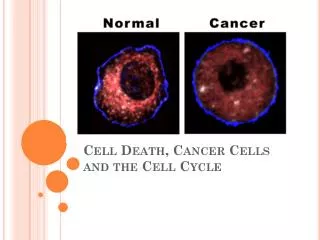
Normal cells become cancer cells when • Cells do not respond to checkpoints
How many chromosomes are in the body cells of an organism that has a haploid number of 10 • 20
Somatic cells are • Body cells • diploid
Gametes are • Sex cells • haploid
Crossing over occurs during • Meiosis • Prophase 1
What provides new genetic combinations? • Random fertilization • Random alignment • Crossing over
DNA is in the form of _____ when the cell is not dividing • chromatin
Harmful cancer • malignant
Checkpoints are checking for: • Is cell big enough • Are spindle fibers attached to chromosomes correctly • Is DNA copied correctly
Harmless cancers • benign
The failure of the chromosomes to separate during division is called: • Nondisjunction
Signs of Cancer? • Caution • ABCD
What phase of mitosis do chromosomes become visible • prophase
How many pairs of chromosomes are present in body cells? • 23
Differentiate between mitosis and meiosis • Crossing over • Two divisions • Haploid • 4 cells • Produces gametes (sperm/egg)
Growth of new blood vessels to support tumors is called _________. • angiogenesis
What is trisomy 21? • Down Syndrome
What is monosomy X? • Turners Syndrome
What is XXY • Klinefelter syndrome