
ISO Certification
E N D
Presentation Transcript
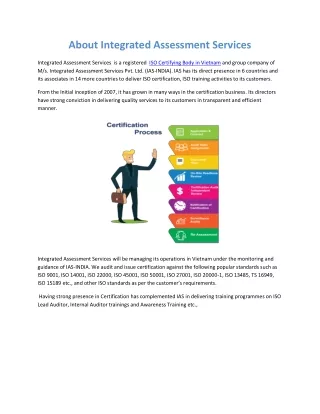
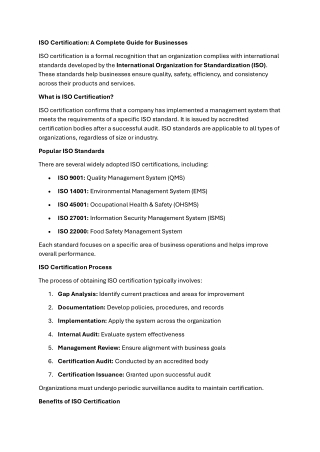
ISO Certification: A Complete Guide for Businesses ISO certification is a formal recognition that an organization complies with international standards developed by the International Organization for Standardization (ISO). These standards help businesses ensure quality, safety, efficiency, and consistency across their products and services. What is ISO Certification? ISO certification confirms that a company has implemented a management system that meets the requirements of a specific ISO standard. It is issued by accredited certification bodies after a successful audit. ISO standards are applicable to all types of organizations, regardless of size or industry. Popular ISO Standards There are several widely adopted ISO certifications, including: •ISO 9001: Quality Management System (QMS) •ISO 14001: Environmental Management System (EMS) •ISO 45001: Occupational Health & Safety (OHSMS) •ISO 27001: Information Security Management System (ISMS) •ISO 22000: Food Safety Management System Each standard focuses on a specific area of business operations and helps improve overall performance. ISO Certification Process The process of obtaining ISO certification typically involves: 1.Gap Analysis: Identify current practices and areas for improvement 2.Documentation: Develop policies, procedures, and records 3.Implementation: Apply the system across the organization 4.Internal Audit: Evaluate system effectiveness 5.Management Review: Ensure alignment with business goals 6.Certification Audit: Conducted by an accredited body 7.Certification Issuance: Granted upon successful audit Organizations must undergo periodic surveillance audits to maintain certification. Benefits of ISO Certification
ISO certification offers several advantages: •Improved Quality and Efficiency: Standardized processes enhance performance •Customer Satisfaction: Consistent quality builds trust •Regulatory Compliance: Meets legal and industry requirements •Global Recognition: Accepted worldwide •Competitive Advantage: Helps win new business opportunities Who Needs ISO Certification? ISO certification is suitable for: •Manufacturing companies •Service providers •IT and software firms •Healthcare organizations •Food and beverage businesses •Government and non-profit organizations Any organization looking to improve its processes and credibility can benefit from ISO certification. Why ISO Certification Matters In today’s competitive market, ISO certification demonstrates a commitment to quality and continuous improvement. It helps businesses reduce risks, improve efficiency, and enhance their reputation among customers and stakeholders. Conclusion ISO certification is a valuable investment for organizations aiming for long-term success. By implementing internationally recognized standards, businesses can improve operations, ensure compliance, and gain a strong competitive edge in global markets.