Understanding Ionic Compounds: Naming, Writing Formulas, and Types
This guide provides a comprehensive overview of ionic compounds, including their composition of metals and nonmetals, the nature of cations and anions, and how to write their chemical formulas effectively. Learn the crisscross method for determining formula units, understand binary and ternary ionic compounds, and get tips for naming ionic compounds using proper conventions. Discover the significance of polyatomic ions and the Stock system for metals with multiple oxidation states. Enhance your chemistry knowledge through practical examples and clear explanations.

Understanding Ionic Compounds: Naming, Writing Formulas, and Types
E N D
Presentation Transcript
Types of Compounds Ionic Compounds • Composed of Metals and Nonmetals • Made of metallic cations and nonmetal anions • The electrons lost by the cation are gained by the anion • The cations and anions surround each other. • Smallest piece is a FORMULA UNIT.
Formula Unit • The smallest whole number ratio of atoms in an ionic compound. • Ions surround each other so you can’t say which is hooked to which.
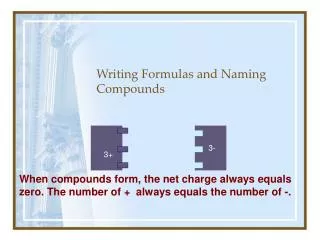
Writing Formulas • The net charge must add up to zero. • Always write the symbol of the metal first and the symbol of the nonmetal second. • Get the charge of each ion. (wants to take on a noble gas configuration)
Criss Cross Method • Cross over method - the charges become the subscripts of the other ion Ba2+ N3- 3 2 Ba3 N2 • Reduce ratio if possible
Binary Ionic Compound • Binary compound - 2 elements • Ca2+ Cl- CaCl2 • K+ S2- K2S
Ternary Ionic Compounds • Have many (more than two) types of elements • Will have polyatomic ions (Table E) • Examples: NO3-1 SO4-2 PO4-3 • Put polyatomics in parenthesis if there is more than one of them • Example: Pb(NO3)2
Naming Ionic Compounds • Binary compound - 2 elements • When naming the compound the name of the metal (+ion) stays the same • The nonmetal (-ion) ends in “ide” • Example: NaCl sodium chloride
Naming Ternary Ionic Compounds Polyatomic ions- use their own name (on Table E) Example NH4Cl ammonium chloride Ba3(PO4) barium phosphate Na OH sodium hydroxide
Stock System Used with elements with more than one oxidation state (charge) - put the oxidation number in Roman numerals in ( )’s. Example: Pb(NO3)2 lead (II) nitrate Transition metals have more then one oxidation number