Halophytic Plants
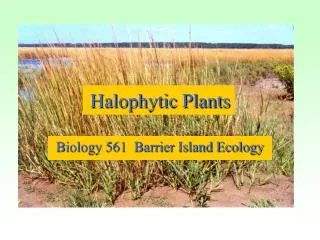
Halophytic Plants. Biology 561 Barrier Island Ecology. Niceties. 80% of the earth is covered by saline water Very few plants are able to tolerate saline conditions without serious damage Plants that survive in saline environments are termed halophytes (c.f., glycophytes)

Halophytic Plants
E N D
Presentation Transcript
Halophytic Plants Biology 561 Barrier Island Ecology
Niceties • 80% of the earth is covered by saline water • Very few plants are able to tolerate saline conditions without serious damage • Plants that survive in saline environments are termed halophytes (c.f., glycophytes) • Most halophytes prefer saline conditions but can survive in freshwater environments • Most halophytes are restricted to saline environments
What is a halophyte? • The term “halophyte” has not been precisely defined in the literature: • Plants capable of normal growth in saline habitats and also able to thrive on “ordinary” soil (Schimper, 1903). • Plant which can tolerate salt concentrations over 0.5% at any stage of life (Stocker, 1928). • Plants which grow exclusively on salt soil (Dansereau, 1957).
What is a halophyte? • Categories of halophilism: • Intolerant Plants grow best at low salinity and exhibit decrease in growth with increase in salinity • Facultative Optimal growth at moderate salinity and diminished growth at both low and high salinities • Obligate Optimal growth at high or moderate salinity and no growth at low salinity
Hypothetical Glycophyte/Halophyte Growth in Various Salinities Facultative Halophyte IntolerantHalophyte Growth Obligate Halophyte Glycophyte Salinity
Halophytism in Higher Plants • Early plants developed in oceanic (i.e., high salinity) environments • Marine algae • Phytoplankton • Cyanobacteria • Land plants seem to have lost the ability to thrive under high salt conditions; most land plants are glycophytes Marine algae (Codium sp.) grow and reproduce in waters with elevated salt content Cyanobacterium Nostoc sp.
Angiosperm Halophyte Types • Marine angiosperms • Mangroves • Coastal strand • Salt marshes
Saline Soils • Possess large quantities of Na+ • Na+ adsorption on clay particles reduces Ca++ and Mg++ content of soils • Marsh soils are typically: • Low in oxygen • High in carbon dioxide • High in methane • Marsh soils are constantly changing due to the ebb and flow of the tides
Water Potential • Water potential is a measure of the free energy (or potential energy) of water in a system relative to the free energy of pure water • The water potential symbol is psi, • Unit of measure (pressure) = megapascals (Mpa) (10 Mpa = 1 bar [approx. 1 atmosphere]) • Pure, free water w= 0 (the highest water potential value)
Components of Water Potential • w total water potential • m matric potential • s osmotic (solute) potential • p pressure (turgor) potential • g gravitational potential • Total water potential (w) = m+s+p+ g
Typical Glycophyte w = m + s + p + g Plant w = 0 + (-0.2) + 0.5 + 0 w = -0.3 Water w = m + s + p + g Soil w = 4.0 + (-0.2) + 0 + (-4.0) w = -0.2
Typical Halophyte w = m + s + p + g Plant w = 0 + (-4.5) + 1.0 + 0 w = -3.5 Water w = m + s + p + g Soil w = 4.0 + (-3.0) + 0 + (-4.0) w = -3.0
Regulation of Salt Content in Shoots Leaf surface containing salt gland of Saltcedar (Tamarix ramiosissima) • Secretion of salts • Salt exported via active transport mechanism • Excretion includes Na+ and Cl- as well as inorganic ions Two celled salt gland of Spartina Photograph and schematic diagram of salt gland of Aeluropus litoralis
Salt Glands in Black Mangrove (Avicennia marina) a (a) sunken gland on upper epidermis; (b) elevated gland on lower epipermis b Concentrations of secreted salts is typically so high that under dry atmospheric conditions, the salts crystallize
Regulation of Salt Content in Shoots • Salt leaching • Not well understood, but results from transport of salts to the near epidermis of leaves; precipitation leaches salts • Salt-saturated leaf fall • Leaves shed after accumulation of salts • Occurs in Hydrocotyle bonariensis and others
Responses to Increased Salts • Succulence Plant organs are thickened due to increased cellular water content • Increased growth Reduces cellular solute concentrations
Seed Dispersal in Halophytes • Most seeds of halophytes are buoyant • Examples are glasswort (Salicornia sp.), coconut (Cocos nucifera), sea rocket (Cakile sp.), and suaeda (Suaeda maritima) • Marine angiosperm seeds are not buoyant • Examples are Thalassia and Halophila
Germination in Halophytes • Germination inhibited by high salt concentrations • Chlorides are very toxic to germinating plants • Optimum germination is in freshwater • Germination response in salt water not necessarily correlated to later growth of a plant species under saline conditions • Higher temperatures slow germination in salt water
Physiological Response in Halophytes • Switch from Carbon-3 photosynthesis to CAM (crassulacean acid metabolism) • Stomates closed during the day • CO2 fixation during the night • Sugars accumulate in cells • Decrease osmotic pressure with organic ions (proteins)