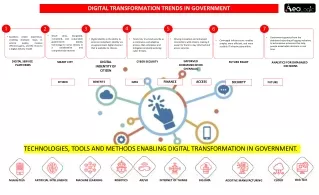
The Evolution and Impact of Digital Government: Enhancing Citizen Engagement through Technology
This overview explores the transformation of governmental institutions through Internet Communication Technology (ICT) at various levels: Government-to-Citizen (G2C), Government-to-Business (GTB), and Government-to-Government (GTG). It outlines the progression from the 1970s to the emergence of e-government initiatives, emphasizing the significance of phases like publishing, interaction, and transaction. Various case studies illustrate successful applications of digital government, highlighting benefits such as increased transparency, cost savings, and improved citizen accessibility to information and services.

The Evolution and Impact of Digital Government: Enhancing Citizen Engagement through Technology
E N D
Presentation Transcript
Digital Government Attributes and Visions Kimberly Stoltzfus, Department of Communication
digital government overview • The use of Internet Communication Technology (ICT) by governmental institutions (local, state, national) to improve information sharing, dialogue, service and transactional processes with its stakeholders
digital government overview (cont.) • There are four levels: • G2C (Gov’t to Citizen) • GTB (Gov’t to Business) • GTG (Gov’t to Gov’t)
digital government overview (cont.) • There are four levels (cont): • IEE (Internal Efficiency and Effectiveness)
digital government overview (cont.) • There are three basic phases: • Publish (e.g., info – one way) • Interact (e.g., comment form, online forums) • Transact (e.g., online services)
digital government overview (cont.) – U.S. timeline • 1970s/80s • PC boom • Research by Kraemer, King and Dutton note that gov’t is unable to keep up with technology • 2002 - 2004 • E-government Act of 2002 • Development of Federal Enterprise Architecture Plan • E-Authentication (2004) • 1991 • www released by Lee • Gopher created • Internet use by individuals • Mid 1993-1995 • National Partnership for Reinventing Government • Web is commercialized • Whitehouse goes online (1993) • USNIIA Act (1993) • 1996 - 2000 • Clinger-Cohen Act – changed acquisition laws and IT management (1996) • E-gov as “capital investment” • First.gov launched (2000)
digital government overview (cont.) • Just some examples: • e-filing • community collaboration • crisis management • e-voting • customer relationship management • eco-informatics • e-rulemaking
U.S. federal digital government • A good case study (GTC, GTB, GTG, and also transact level): Internal Revenue Service’s Business Systems Modernization http://www.irs.gov/newsroom/article/0,,id=98159,00.html • 1999 to present • Antiquated technology from Kennedy Admin • Two prior failed modernization efforts • New effort emphasizes partnerships • Multi-billion, multi-year program affecting everyone! • Info Tech and Improvement Account (ITIA) created
major federal gov’t players Consulting firms: CSC, IBM, BearingPoint, Accenture, SAIC, Lockheed Martin Congress OMB – Office of Management and Budget GAO – General Accountability Office Agency leadership: CIO is tech lead; Secretary/Commissioner is business lead
global examples Canada: Numerous services http://www.canada.gc.ca/ • Italy: Encouraging citizen discussion • http://www.comune.bologna.it Pakistan: Report a crime http://www.punjab.gov.pk • INDIA: Posts court records, case info • http://indiancourts.nic.in/itinjud.htm
cited benefits For citizens: • One stop shop • More government transparency • Easier access to information • Convenience For government organizations: • Cost savings • Instant access to information • More challenging/interesting work • Congress is happy
“successful” digital government • National rankings (Brown University, 2005): http://www.brown.edu/Administration/News_Bureau/2005-06/05-023.html • International rankings: http://www.brown.edu/Administration/News_Bureau/2005-06/05-024.html Accenture 2004 rankings: Canada’s #1 • No standard benchmarking for “success” • Gartner – 60% will fail this year
some problems with U.S. federal digital gov’t • Not knowing the difference between project and endeavor – Gartner • Not getting enough middle managers involved in decision-making – GAO • Not having enough staff who understands the technology – Gov’t CIOs • Bad partnering - Everyone • Not focusing on internal communication efforts - Kim
the future of digital gov’t • M-government: Mobile Government • System: Combination of portable mobile devices and wireless Internet access • Devices: PDAs*, cellphones, BlackBerry, Tablet PC • Wireless: Cellular, Wi-Fi, Bluetooth, Satellite, Infrared (IR)
the future of digital gov’t U.S. (G2C): • Commonwealth of VA: Tracking election returns via PDA • Iowa: Parking day SMS • Seattle: GPS system Mobile Traffic Map (G2G): • San Francisco: Wi-Fi Police Networks • U.S. Navy: Field Inspections (PDA) • Texas: Tax information (Tablet PC)
the technology and society perspective – some questions GLOBAL: • What are the decision-making criteria for pursuing e-government? • Does Internet transform gov’t (i.e., democracy) or just re-create what already exists? LOCAL/COMMUNITY/NATIONAL: • So, what happens to all those emails and comments that are sent? • Will control of dialogue change? • Will we be more trusting of government?