Download
1 / 2
20 likes | 130 Views
This study explores the complexity of transcriptional regulatory networks focusing on heterogeneous topological modules that integrate various signal sensing classes. It highlights key observations regarding transcription factors (TFs) and their families, emphasizing the combinatorial control of global and local regulation in feed-forward loops (FFLs) and Bifans, which bridge distinct regulatory modules. The research illustrates how modules integrate both endogenous and exogenous signals and showcases network motifs, differentiating TFs based on their signal sensing capabilities.

E N D
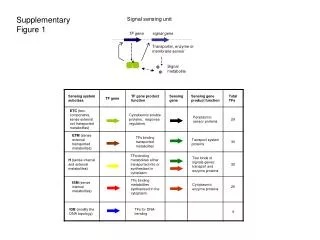
TF gene signal gene Transporter, enzyme or membrane sensor Signal metabolite Supplementary Figure 1 Signal sensing unit
P Supplementary Figure 2 External sensing TF Module 1 FFL motif Module 2 Bifan motif (complex regulon) Internal sensing TF SIM motif (simple regulon) Supplementary figure 2. Scheme showing the main observations of this work. Topological modules in the transcriptional regulatory network are heterogeneous in the context of sensing classes. TF-families were also found to be heterogeneous. Most modules integrate endogenous and exogenous environment thus resulting in a combinatorial control of global and local regulation in FFLs. BIFANs link different modules predominantly through internal sensing classes. The main network motifs analyzed in the paper are exemplified with their corresponding simple and complex regulons. Red and blue nodes represent TFs for endogenous and exogenous signal sensing while grey nodes represent target genes; P, periplasmic membrane.