Enhancing Educator Evaluation in Washington State: Module 2 Insights and Strategies
This session focuses on utilizing instructional and leadership frameworks in educator evaluation, emphasizing the critical role of teacher and principal quality. Participants will engage in discussions about recent updates in Teacher and Principal Evaluation Pilot (TPEP) work, share resources, and explore effective strategies for evaluating educators. By participating, attendees will learn to articulate evaluation criteria, identify appropriate measures, and understand legislative requirements, ultimately fostering a culture of continuous professional growth and development.

Enhancing Educator Evaluation in Washington State: Module 2 Insights and Strategies
E N D
Presentation Transcript
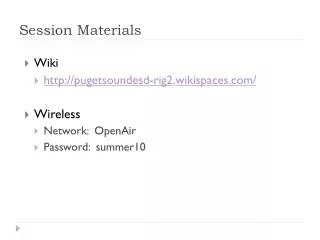
Session Materials • Wiki • http://pugetsoundesd-rig2.wikispaces.com/ • Wireless • Network: OpenAir • Password: summer10
Washington State Teacher and Principal Evaluation Module 2: Using Instructional and Leadership Frameworks in Educator Evaluation
Session Norms • Be present • Participate actively: • Ask questions • Share connections • Listen • Work together as a community • Invite and welcome contributions of every member
District Updates • What has occurred in your TPEP work since we last met? • Communication with stakeholders • Resources created or found • Other thoughts/ideas that might be helpful to other RIG districts
TPEP Core Principles • The critical importance of teacher and leadership quality • The professional nature of teaching and leading a school • The complex relationship between the system for teacher and principal evaluation and district systems and negotiations • The belief in professional learning as an underpinning of the new evaluation system • The understanding that the career continuum must be addressed in the new evaluation system • The system must determine the balance of “inputs or acts” and “outputs or results”
RIG Content Over Five Sessions • Introduction to Educator Evaluation in Washington • Using Instructional and Leadership Frameworks in Educator Evaluation • Applying Multiple Measures of Performance • Including Student Growth Measures in Educator Evaluation • Conducting High-Quality Observations • Providing High Quality Feedback for Continuous Professional Growth and Development
Overview of Intended Participant Outcomes for Session 2 Participants will know and be able to: • Articulate the relationship between the revised teacher and principal evaluation criteria and the frameworks • Identify measures and evidence to use for teacher and/or principal evaluation • Understand the legislative requirements for instructional and leadership frameworks as part of the Teacher and Principal Evaluation Pilot (TPEP) • Understand and utilize system level components for teacher and principal evaluation
Learning: Understanding the Relationship Between Criteria and Frameworks Determine the relationship between the revised teacher and principal evaluation criteria and the frameworks
TEACHER EVALUATION CRITERIA
PRINCIPAL EVALUATION CRITERIA
Teachers: “fostering and managing a safe, positive learning environment.” “collaborative and collegial practices focused on improving instructional practice and student learning.” Principals: “creating a school culture that promotes the ongoing improvement of learning and teaching for students and staff.” “providing for school safety.”
Teachers: “using multiple student data elements to modify instruction and improve student learning.” Principals: “development, implementation, and evaluation of a data-driven plan for increasing student achievement, including the use of multiple student data elements.”
Teachers: “providing clear and intentional focus on subject matter content and curriculum.” Principals: “assisting instructional staff with alignment of curriculum, instruction, and assessment with state and local district learning goals.”
Teachers: Implementing the instructional framework Principals: “monitoring, assisting, and evaluating effective instruction and assessment practices.”
Teachers: “communicating and collaborating with parents and school community.” Principals: “partnering with the school community to promote learning.”
1. Divide up the teacher and/or principal criteria so pairs have one or two to examine.2. Teacher: Use the At-A-Glance document to find where the criteria are represented in your framework.Principal: Use the AWSP framework.3. Make notes about what the framework says that adds clarity for each criteria. Connect Criteria and Frameworks
Educator Evaluation Measures: It Takes Many Pieces… Planning Classroom Observation Perception Survey Data Self-Assessment & Reflection Peer Evaluation Portfolio Assessments Student Work Samples Student Learning/ Achievement Data
Measures and Evidence • Used to determine the teacher’s or principal’s performance along a continuum that indicates the extent to which the criteria have been met or exceeded • Should have strong correlation to criteria being evaluated
Brainstorm: Measures and Evidence • For each criterion: • Consider the notes you took from the framework, and read (or reread) what your rubric says for that criterion. • Discuss the kinds of evidence that could be collected to show evidence of that criterion • Record an “x” in the box if that is something to consider • Brainstorm an initial list of the specific evidence sources • Resources: NCCTQ report, Summary
Job Alike Groups • Find one or two other people with your same job role • Share potential sources of evidence and discuss
In District Teams • Share ideas gathered from partner and job-alike conversations • Make notes of next steps to take during planning time
Team Planning Ideas • Update Communication Plan: Who else needs this information? • Identify decisions that need to be made given the “rules” and suggested teacher evaluation process and begin decision making process. • Continue working to identify measures and evidence. • Other…
Implementing Articulate the ways an instructional and leadership framework can operationalize the revised evaluation system to improve teaching and learning Analyze the instructional frameworks to support district decision-making in selecting an instructional framework and a leadership framework
Team Time Debrief • Each team share: • One decision you made today (could be a key decision, a preliminary decision, a change of course, etc.) • One of the immediate next steps you are taking when you return to your district
Whip Around and Plus/Delta Debrief • Whip Around: One significant “ah-ha moment” today • Take a few minutes and create at least two sticky notes for the Plus/Delta Chart on your way out. • Plus: What was a real “plus” of today’s session? What went well and should be repeated? • Delta: Where is there room for improvement and change?