Download
1 / 7
70 likes | 174 Views
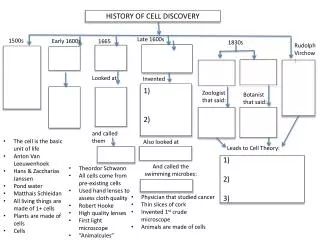
Explore the fascinating journey of cell discovery, starting with Anton van Leeuwenhoek's observations and Robert Hooke's groundbreaking work in 1665, where he named the tiny structures in cork "cells." Understand the foundational principles of cell theory proposed by Schleiden and Schwann, which encompass the ideas that all life is made of cells, cells are the basic units of life, and new cells arise from existing ones. Dive into cell diversity and categories, including prokaryotes and eukaryotes, and discover how cell shape relates to function.

E N D
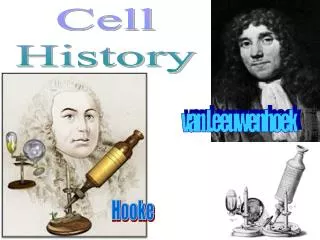
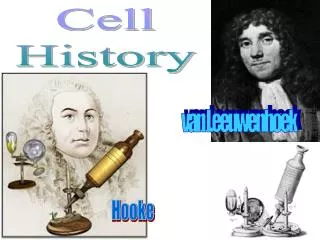
Cell History van Leeuwenhoek Hooke
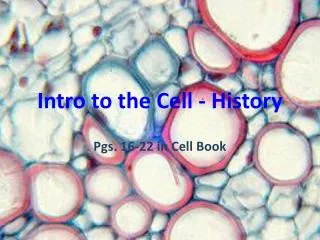
Cell History • All life is made of cells • Discovered after microscope invented • 1665: Robert Hooke first observed cork (dead plant bark) • Cork reminded him of tiny rooms • He named the empty boxes “cells”
Cell Theory Schleiden • Three Parts: • 1) All organisms are made of cells • 2) The cell is the most basic unit of life • 3) Cells come from other cells • What’s the big problem with this theory? Schwann Virchow
Cell Diversity • Shape depends upon function • Nerve Shape: Elongated branching • Function: Sends messages to and from brain • Red Blood Shape: Disc-like shape prevents clogging • Function: Carries O2 throughout blood • Skin Shape: Flat & broad; layers overlap • Function: Covers and protects the body
Cell Categories • 1) Prokaryote: Cells without a nucleus and other membrane-bound organelles • Oldest cells known (~4 billion years old) • Believed to have evolved first (oldest fossils) • AKA: Bacteria
2) Eukaryote: Cells with a nucleus & membrane bound organelles More complex cells Evolved from prokaryotes Ex: Protists, Fungi, Plants, Animals Cell Categories
QuickReview • Cells shape is related to its job (function) • Cells are the basic units of life • Cells come from other cells