Understanding Different Types of Mental Disorders and Their Recognition
This text explores four distinct ways to recognize mental disorders, providing examples for each category. The classifications include mood disorders, like bipolar disorder; depression, characterized by extreme sadness and hopelessness; schizophrenia, which entails severe distortions of thought and awareness; and impulse control disorders, where individuals struggle to resist harmful behaviors, such as gambling or kleptomania. Additionally, personality disorders are discussed, highlighting their rigid behavior patterns that hinder interpersonal relationships.

Understanding Different Types of Mental Disorders and Their Recognition
E N D
Presentation Transcript
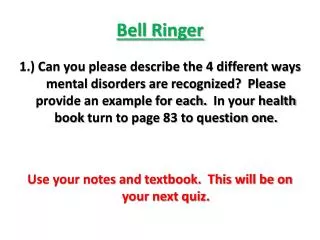
Bell Ringer 1.) Can you please describe the 4 different ways mental disorders are recognized? Please provide an example for each. In your health book turn to page 83 to question one. Use your notes and textbook. This will be on your next quiz.
News You Can Use Bryan Jackson doing well after being injected with the HIV / AIDS virus by his father.
News You Can Use Making eye contact doesn’t always help your cause.
Objective Describe and Explain the 4 other types of mental health disorders.
Mental Health - Mood Disorder Mood Disorder – extreme emotions that make it difficult to function with daily life EXAMPLE: BIPOLAR DISORDER
Mental Health - Depression Depression – An emotional state where an individual feels extremely sad and hopeless.
Mental Health - Schizophrenia Schizophrenia – severe distortion of thoughts, mood and awareness. “Split Mind”
Mental Health - Impulse Control Impulse Control – individuals that cannot resist to act in a way that is harmful to themselves or others. • Gambling • Poker • Pornography • Kleptomania
Mental Health - Personality Disorders Group A: Cold, Distant, Paranoid. Group B: Extremely emotional, selfish and demanding. Group C: Cannot make decision on their own. People with Personality Disorders display rigid patterns of behavior that make it difficult to get along with others.