Download
1 / 71
710 likes | 839 Views
This session covers essential techniques for effective network security monitoring, device status identification, traffic analysis, and attack identification. Learn to utilize tools for monitoring CPU load, memory, and temperature, as well as analyzing network traffic using Netflow and packet sniffers. Explore traffic statistics, including bandwidth and packet per second (PPS) metrics, and understand abnormal traffic patterns. Gain insights into routing protocol status, including BGP monitoring and stability. Equip yourself with the knowledge to safeguard your network and efficiently respond to potential threats.

E N D
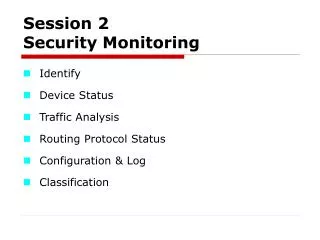
Session 2Security Monitoring • Identify • Device Status • Traffic Analysis • Routing Protocol Status • Configuration & Log • Classification
Device Status • CPU • Memory • Temperature
Traffic Analysis • Technology (Netflow & Sniffer) • Layer 3 or 4 based • Application based
Layer 3 or 4 TOP N • IP address based • Protocol based • Port based • Packet Size based • AS based
overview Normalin/Normalout Spoofin/Spoofout Bandwidth、PPS and Packet Size
Traffic Statistics Picture • According to bandwidth bandwidth、packet size and PPS • According to direction normalin/normalout spoofin/spoofout • According to time 4 hours,2 days,1 week,2 months • max,min,average,now
IP TOP 20 • Order by source/destination address • Order by source destination peer • Order by bandwidth and PPS
Packet size TOP20 Order by bandwidth、 PPS
Port Distribution TOP20 • Order by sour/dest port summary • Order by sour/dest port direction • Order by bandwidth and pps
Protocol statistic TOP20 • According to protocol normalin、normalout、spoofin and spoofout • Order by bandwidth and pps
Protocol Picture • According to bandwidth and pps • According to type TCP UDP ICMP • According to time 4hours,2day,1week,2month • Max, min, average, now
AS Statistic TOP20 • According to directionnormalin、normalout、spoofin and spoofout • According to bandwidth and pps
Routing Protocol Status • Route Entries • Routing Protocol Stability