Download
1 / 9
100 likes | 230 Views
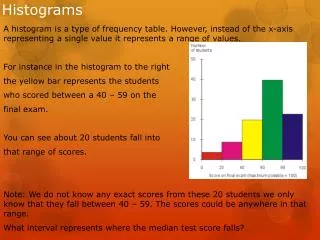
Histograms are essential for visualizing large sets of continuous data, such as mass, height, or time. They are particularly useful when data is presented in grouped frequency distributions, with unequal class widths and no gaps between bars. This ensures that the area of each bar represents frequency, calculated by multiplying the frequency density by the class width. Properly drawing histograms involves using sensible scales, aligning bases, and accurately plotting class boundaries to depict data trends and distributions effectively.

E N D
HISTOGRAMS Representing Data OCR Module 9
Why use a Histogram • When there is a lot of data • When data is • Continuous • a mass, height, volume, time etc • Presented in a Grouped Frequency Distribution • usually in groups or classes that are UNEQUAL
NO GAPS between Bars Continuous data
Bars are different in width Determined by Grouped Frequency Distribution
So we use FREQUENCY DENSITY AREA is proportional to FREQUENCY = Frequency Class width NOT height, because of UNEQUAL classes!
Grouped Frequency Distribution Classes
Drawing • Sensible Scales • Bases correctly aligned • Plot the Class Boundaries • Heights correct • Frequency Density
Frequency Densities Class width 40 10 10 30 20 2.0 1.5 2.5 3.0 1.5
3.0 2.0 1.0 0 20 40 60 80 100 120 Frequency = Width x Height Freq Dens Frequency = 40 x 2.0 = 80 Speed (kph)