Download
1 / 11
110 likes | 121 Views
Detailed comparison study carried out in 2000 for ISO/TC22/SC5/WG10 on RLD methods and calculations. Presenting data extraction for GTR-compliant tests. Evaluation of different testing methods including wind tunnel, Ch. Dynamometer, and road tests. Analysis on repeatability, vehicle performance, and deviations. Conclusions on method equivalency for vehicle testing.

E N D
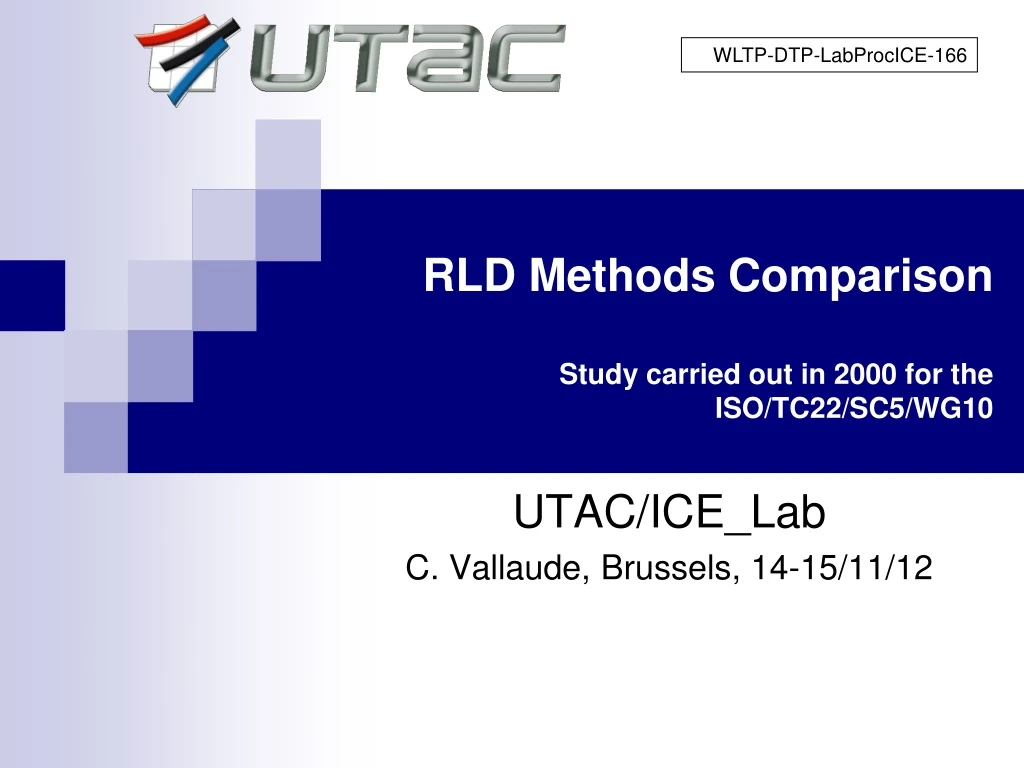
WLTP-DTP-LabProcICE-166 RLD Methods Comparison Study carried out in 2000 for the ISO/TC22/SC5/WG10 UTAC/ICE_Lab C. Vallaude, Brussels, 14-15/11/12
Study Presentation (1/2) • Study: done in 2000 for the ISO group => Was presented to the group in June 2001 • Objective : compare different RLD methods and calculations • Objective today: extract the data corresponding to tests complying with the GTR methods
Study Presentation (2/2) • Test Vehicles => Obj : cover the extreme situations • 1 Small M1 • 1 N1 • Tests methods • Wind tunnel + Ch. Dynamometer => Alternative Method • Road => ISO10521 (samemethod as annex 4, §4.3.1.4 of draft GTR)
Test methods (1/2) • Alternative method (Tunnel +Ch/Dy) • Scxmeasured in 2 wind tunnels • Frictions measured on 2 chassisdynamometers • Measurements of rollingresistanceloads made up to 120 km/h • Warm up of axles : 30min at 120km/h for rear, 20min at 120km/h for front
Test methods (2/2) • Road method • 1 road • Almostzeroslope • Length: ~2 km => thus 2-part CD (120-80km/h & 80-20km/h) • Generally warm, quitesunny conditions ( ~20 °C) • Low speed windsfrom 0 to 3 m/s
Repeatability (1/2) • Road testing • Maximum difference from 1% to 4.4% between two tests
Repeatability (2/) • WT + ChDy testing • Maximum difference from 2% to 4% (including 2 wind tunnels and 2 ChDy)
WT + Ch/Dy & Road LW (1/2) • Road data are averaged over 4 tests for both vehicles • Opposite trends with the 2 vehicles
Conclusion • Max difference for road testing around 4% at low wind • Max difference for WT + ChDy around 4% • deviations for both methods • Comparison WT+ChDy & Road • For V1 -2.4% to -4.7% • For V2 +2.1% to +2.9% • depends on vehicle • Conclusion in 2001, equivalency of both methods