Exponential Growth and Compound Interest Calculations for Savings Accounts
130 likes | 254 Views
This comprehensive guide explores exponential growth equations utilizing the natural base and horizontal asymptotes, specifically focusing on y = -2. It presents examples of account balances from various principal amounts, including scenarios of compounded monthly and quarterly interest rates. Key calculations for deposits of $2,000 at 5%, $3,000 at 3.5%, and $725 at 4.5% with different compounding frequencies are detailed. Learn how to determine future amounts using the formula A = P(1 + r/n)^(nt) and understand continuous compounding mechanics.


Exponential Growth and Compound Interest Calculations for Savings Accounts
E N D
Presentation Transcript
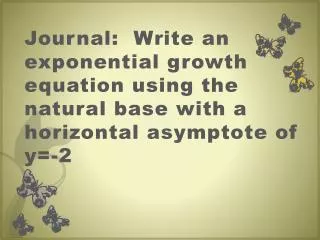
Journal: Write an exponential growth equation using the natural base with a horizontal asymptote of y=-2
Account Balance: • You deposit $2000 in an account that earns 5% annual interest. Find the balance after 2 years if the interest is compounded monthly.
Compound Interest • A –future amount • P – Principal (initial amount) • r – annual rate of interest • n – number of time compounded annually • t – time left in account
Account Balance: • You deposit $2000 in an account that earns 5% annual interest. Find the balance after 2 years if the interest is compounded monthly.
Account Balance: • You deposit $3000 in an account that earns 3.5% annual interest. Find the balance after 3 years if the interest is compounded quarterly.
Account Balance: • You deposit $725 in an account that earns 4.5% annual interest compounded continuously. Find the balance after 3 years.
Compound Interest • A –future amount • P – Principal (initial amount) • e –irrational number on calculator • r – annual rate of interest • t – time left in account
Account Balance: • You deposit $725 in an account that earns 4.5% annual interest compounded continuously. Find the balance after 3 years.
Account Balance: • You deposit $3000 in an account that earns 3.5% annual interest. Find the balance after 3 years if the interest is compounded continuously.
Polish your evaluating exponential functions • Complete the worksheet on calculating interest
Assignment • Interest worksheet
Exponential Decay Model Exponential Growth Model
Assignment • Exponential Model worksheet