Download
1 / 11
110 likes | 234 Views
This overview presents a comprehensive understanding of dementia, including its common types like Alzheimer’s disease, vascular dementia, and Lewy bodies dementia. It outlines the diagnostic process, involving referrals for assessment, blood tests, and imaging techniques. The symptoms of dementia—progressive memory loss, confusion, and personality changes—are discussed, along with medications that may provide symptomatic relief. Effective communication strategies and care considerations, particularly in hospital settings, are also addressed, emphasizing the importance of maintaining individual independence.

E N D
Dementia-A new understanding Shir Garnett DASNI and Dianne van Clarke- Alzheimer’s WA
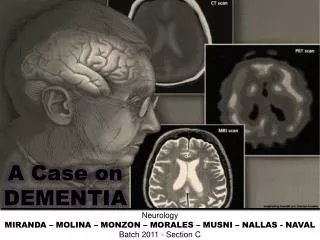
Diagnosis • The GP and/or family suspect dementia may be present and refers patient for further assessment. • Full bloods to check if there is nothing else causing changes • CT scan, MRI, SPECT • Seniors Mental Health Team for a Hierarchical Dementia Scale (HDS) assessment
Types of dementia • Alzheimer’s disease –50-70% • Gradual changes. Build up of “tangles” in centre of brain cells and “plaques” outside brain cells, disrupting messages within the brain. • Vascular Disease-2nd most common • Problems of the circulation of blood to the brain eg. TIA’s • Lewy Bodies Dementia • Degneration and death of nerve cells in the brain caused by abnormal lumps inside nerve cells known as Lewy bodies • Over 100 different types of dementia
Incidence of dementia • 162,000 people in Aust over 65 estimated to have dementia • By 2006- 195,000 over 65 with moderate to severe dementia • In City of Albany- Sept-2002 estimated 296 people • People as early as 30’s and 40’s. Prevalence • 65-69yrs about 1 in 70 • 75-79 about 1 in 18 • 80-84 about 1 in 9
How dementia affects somebody • Symptoms- • Progressive and frequent memory loss • Confusion • Personality change • Apathy and withdrawal • Loss of ability to do everyday tasks • Changes- Three stages. Known as early stage, moderate to late • Early onset (under age of 65)
Medications • Cholinergic treatments offer symptomatic relief for some people for a limited period of time • Available under PBS under certain conditions • Acetycholinesterase Inhibitor Drugs • Donepezil Hydrochloride –Aricept • Rivastigamine-Exelon • Galantamine Hydrobromide-Reminyl • Ebixa • Side Effects- • When first taking them-GI, muscle cramps, insomnia, fatigue, loss of appetite. Also dizziness and nightmares. Need to increase doses gradually
Communicating with someone with dementia • Remain calm and talk in a gentle, matter of fact way (Determine level of understanding of person) Don’t be condescending. • Keep sentences short and simple, focusing on one idea at a time • May need to repeat instruction many times. • Body language –made up of 55% of our communication • Avoid background noise and distraction • Validation therapy-going into their reality! • Reminiscence
Admission into hospital • Gather relevant history on patient, from carer if required. Including social profile. • Note possible illnesses that may cause pain and how this is expressed if comunication limited. Use of Pain Charts • Make sure everyone knows diagnosis of dementia but do not make any assumptions of inabilities..find out what they can do • Private room if possible or same room
While in hospital • Allocate staff according to their skills and interest and try to be consistent • Maintain independence –don’t assume they cannot do own ADL’s. May need increased guidance as in unfamiliar environment • Minimise physical and chemical restraints
Discharge from hospital • Inform carer of any changes to treatment and medications. Where possible in writing. • Check if home situation needs modifications. • Referral for follow up support –Use of Dementia directory.
So what’s with the turtle? • D- Dementia • A- Advocacy and • S-Support • N- Network • I-international