Download
1 / 23
230 likes | 320 Views
Discover the fascinating world of William Shakespeare, his plays, sonnets, and theatrical innovations. Learn about the Globe Theater, staging, actors, and poetic styles. Unravel Shakespearean language and literary devices.

E N D
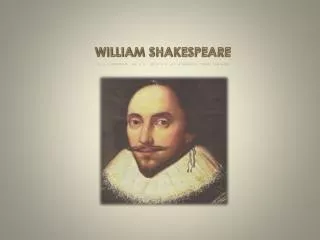
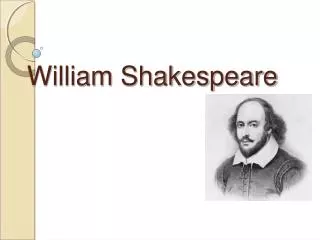
William Shakespeare Widely regarded as the greatest writer in English Literature
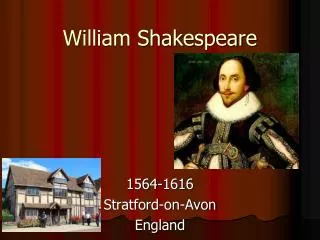
Shakespeare • 1564-1616 • Stratford-on-Avon, England • wrote 37 plays • about 154 sonnets • started out as an actor
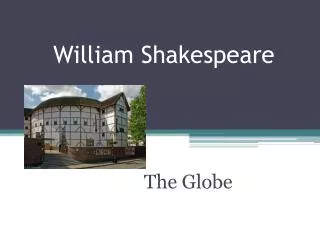
Stage Celebrity • Actor for Lord Chamberlain’s Men (London theater co.) • Also their principal playwright • 1599> Lord Ch. Co. built Globe Theater where most of Shakespeare’s play’s were performed
Shakespeare wrote: • Comedies • Histories • Tragedies
Romeo and Juliet • Written about 1595 • Considered a tragedy • West Side Story (Movie) based on R&J
The Theater • Plays produced for the general public • Roofless>open air • No artificial lighting • Courtyard surrounded by 3 levels of galleries
Spectators • Wealthy got benches • “Groundlings” • Poorer people stood and watched from the courtyard called the “pit” • All but wealthy were uneducated/illiterate
Staging Areas • Stage - platform that extended into the pit • Dressing & storage rooms in galleries behind & above stage • second-level gallery • Trap door>ghosts • “Heavens”> angelic beings
Differences • No scenery • Settings > references in dialogue • Elaborate costumes • Plenty of props • Fast-paced, colorful>2 hours!
Actors • Only men and boys • Young boys whose voices had not changed play women’s roles • Would have been considered indecent for a woman to appear on stage
Iambic Pentameter • Each line has 10 syllables (any number of words) • Broken down into 5 groups of 2 syllables (iamb) • In each iamb, the 2nd syllable is stressed (emphasized / ), and the first is unstressed (U) • Blank Verse- a poem in iambic pentameter that does not rhyme (unrhymed) • Rhyming Couplet- two rhyming lines (will usually complete a long speech or a scene)
Shakespearean Sonnet • 14 lines in iambic pentameter • 3 quatrains (four-line stanzas) and a concluding couplet (two rhyming lines) • First 8 lines - morbid mood • Last 6 lines- express joy, or at least some resolution to sorrows • Ends with a rhyming couplet • Rhyme Scheme: ABAB CDCD EFEF (3 quatrains) GG (rhyming couplet)
Prose • Ordinary writing that is not poetry, drama, or song • Only characters in the lower social classes speak this way in Shakespeare’s plays • Why do you suppose that is?
Tragedy (Shakespearean) • Drama where the central character/s suffer disaster/great misfortune • In many tragedies, downfall results from> • Fate • Character flaw/Fatal flaw • Combination of the two
Monologue • One person speaking on stage > may be other character on stage too • ex > the Prince of Verona commanding the Capulets and Montagues to cease feuding
Soliloquy • Long speech expressing the thoughts of a character alone on stage.
Aside • Words spoken, usually in an undertone not intended to be heard by all characters
Dramatic Foil • A character whose purpose is to show off another character • Benvolio for Tybalt • look for others in R & J
Pun • Shakespeare loved to use them!!! • Humorous use of a word with two meanings > sometimes missed by the reader because of Elizabethan language and sexual innuendo
Dramatic Irony • A contradiction between what a character thinks and what the reader/audience knows to be true
Verbal Irony • Words used to suggest the opposite of what is meant
Situational Irony • An event occurs that directly contradicts the expectations of the characters, the reader, or the audience