Understanding Simple Harmonic Motion: Concepts, Examples, and Calculations
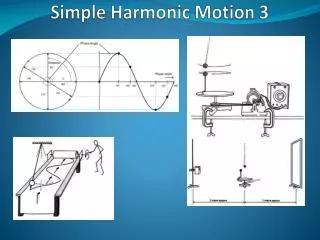
Simple Harmonic Motion (SHM) describes the oscillation of objects like springs and pendulums, moving back and forth over the same path. Key terms include Period (T), Frequency (f), and Amplitude (A). This guide explores calculations for mass using spring constants, the vibrations of car shocks, and pendulum oscillations both on Earth and the Moon. Learn how to determine the period of vibrations when encountering road irregularities and the effects of gravitational differences on pendulum swings. Engage with practical examples for better comprehension of SHM.

Understanding Simple Harmonic Motion: Concepts, Examples, and Calculations
E N D
Presentation Transcript
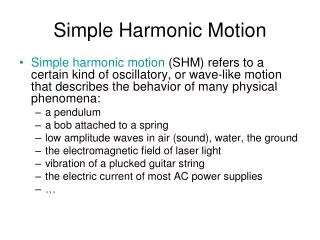
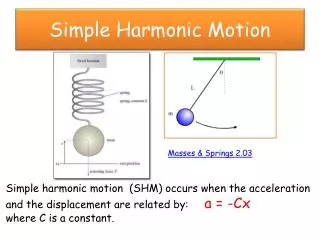
Simple Harmonic Motion (SHM) SHM occurs when an object oscillates back and forth over the same path. Examples
SHM Terms • Period, T, the time it takes to execute one complete cycle of motion. • Units: • Frequency, f, the number of cycles or vibrations per unit time. • Units: • Amplitude, A, the maximum distance traveled by an object away from its equilibrium position. • Units:
Finding Mass An object is attached to a spring and executes SHM with a period of 0.25 s. If the spring constant of the spring is 126.3 N/m then what is the mass of the object?
Car Shocks A 1300 kg car is constructed on a frame supported by four springs. Each spring has a spring constant of 20,000 N/m. If two people riding in the car have a combined mass of 160 kg, find the: • Period of the vibration of the car when it is driven over a pothole in the road. • Frequency of the vibration of the car. • How long does it take the car to execute 3 complete cycles?
Period of a Pendulum A simple pendulum of length 2 m oscillates on earth. • How many complete oscillations does it make in 5 min? • What is the period of the pendulum on moon where the force of gravity is 1/6 that of earth?