Understanding Simple Harmonic Motion and Wave Properties
This comprehensive guide explores Simple Harmonic Motion (SHM) and the properties of waves. SHM is characterized by periodic motion with a restoring force proportional to displacement, manifesting in systems like springs and pendulums. We delve into Hooke’s Law, energy potential, and the calculation of wave periods. The study of waves includes types such as transverse and longitudinal, their properties like wavelength, frequency, and amplitude, as well as concepts of superposition, interference, and reflection. Essential for physics students, this content clearly outlines key concepts in motion and wave mechanics.

Understanding Simple Harmonic Motion and Wave Properties
E N D
Presentation Transcript
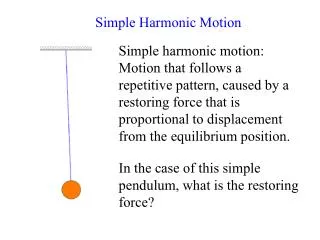
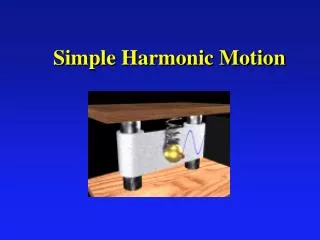
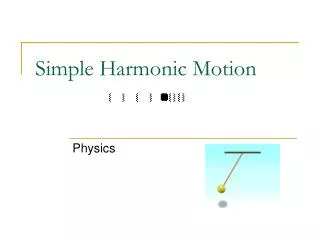
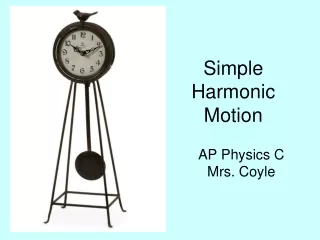
Simple Harmonic Motion • Periodic motion that has a restoring force that is proportional to its displacement • Back and forth motion (repetitive motion) • Springs, Pendulums, Waves
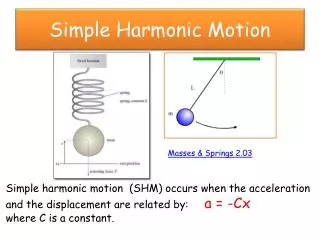
Types of SHM Springs • Hooke’s Law – F = -kx • PE = ½kx2 • Period (T) = 2m/k Pendulums • Period (T) = 2L/g
Waves • Carry energy • Pulse – a single disturbance of a wave • Transverse vs. Longitudinal • Mechanical vs. Electromagnetic
Types Transverse vs. Longitudinal • T – energy and movement are perpendicular • Example – the “wave” done by sports fans during an event • L– energy and movement are parallel • Example – a mosh pit Mechanical vs. Electromagnetic • M – requires a medium(source) in order to travel • Example - sound • E – does NOT require a medium to travel • Example - light
Properties • Wavelength – distance from one area to the next corresponding area on a wave • Frequency – the number of waves that pass a point in a certain amount of time • Amplitude – the amount of energy carried by the wave (E is proportional to A2)
Properties • Speed – how fast a wave moves = its determined by the MEDIUMin which the wave travels • Speed = distance = wavelength * frequency time • When a wave enters a new medium, the wavelength changes while the frequency stays the same
SuperpositionThe combining of two or more waves Constructive Interference • All the waves are going in the same direction and are in sync with one another • Waves add together Destructive Interference • All the waves are NOT in the same direction and are NOT in sync with one another • Waves cancel out
Reflection Free Boundary • End is ABLE to move • Reflected wave is the same as incident wave Fixed Boundary • End is UNABLE to move • Reflected wave is the inverse of incident wave
Refraction • The bending of waves as they move from one medium to another
Diffraction The bending of waves through an opening or around a barrier Think of water waves
Sound Waves • Speed of sound in air is 343 m/s • Require a medium = mechanical • Longitudinal • Echo = reflection of sound • Pitch = how high or low a sound is = frequency • Loudness = depends on the amplitude
Light Waves • Speed of light in vacuum = 3.0 X 10⁸ m/s • Does NOT require a medium = electromagnetic • Transverse • Mirrors = reflection of light • Lenses = refraction of light
Types of Reflection Specular Diffuse
Law of Reflection Angle of incidence = angle of reflection
Mirrors Flat, Plane Mirrors Bathroom mirrors Concave Used for magnification Convex Makes images smaller Used in side mirrors of cars
Lenses Concave • Used the make images smaller Convex • Used in camera lenses, microscopes, magnifying lenses