Download
1 / 10
100 likes | 205 Views
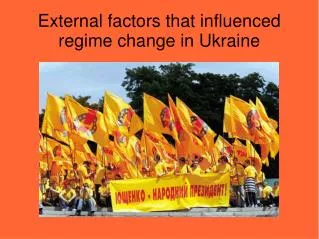
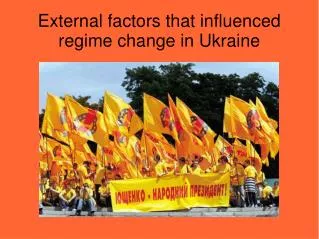
Explore how Ukraine's international position, external actors, ties to the West, and constraints shaped its regime change. Discover Ukraine's relationship with the EU, Russia, and Western powers, and the impact of foreign financial and social support during the Revolution.

E N D
Overview 1. General presentation of Ukraine's position in the international area before Revolution 2. Relevant external actors, structures during Revolution 3. Linkage to the West 4. External constraints 5. Summary
Ukraine's position in the international area before Revolution • Newly Independent State • Considered as an extension of Russia • Never a full – blown autocracy, semiautoritharism • Less preferable than Russia • 1994 Partnership and Cooperation Agreement with the EU • 1999 EU's Common Strategy • The largest trade partner and foreign investor • Black Sea region
External actors and their influence The EU – financial support Kremlin – financial support Foreign NGO's (IRI, NDI, Freedom House, CVU, the Democratic Initiatives Foundation) – financial, social support Russian Television (ORT, RTR, NTV)
Ties with “West” during Revolution Western cooperation with Ukrainian organizations Znayu, Pora, KMIS – voter mobilization, exit polls Financial support: 18 mln $ from the USA, 70 mln $ per year in 2004 – 2006 and 123 mln in 2007 – 2010 from the EU, donations from the US and Canadian citizens for Our Ukraine Financial programms: TACIS, EDHIR, TEMPUS
External constraints Potential membership in the EU Relations with Russia Geopolitical interests of the EU
Summary Russia is still superior international partner for the West Western powers didn't recognize Ukraine elites issue Low Western linkage – weak democratizing pressure
Bibliography Gawrich Andrea, 2010, Neighbourhood and Europeization McFaul Michael, 2007, Ukraine Solonenko, 2009, Extnernal Democracy Promotion Youngs Richard, 2009, EU and Orange Revolution