The Sun
250 likes | 389 Views
Discover the fascinating world of our Sun, a star made of gases that powers life on Earth through nuclear reactions and emits various forms of radiation. Learn about its size, atmosphere, energy, and impact on Earth, as well as its place among other stars in the universe.


The Sun
E N D
Presentation Transcript
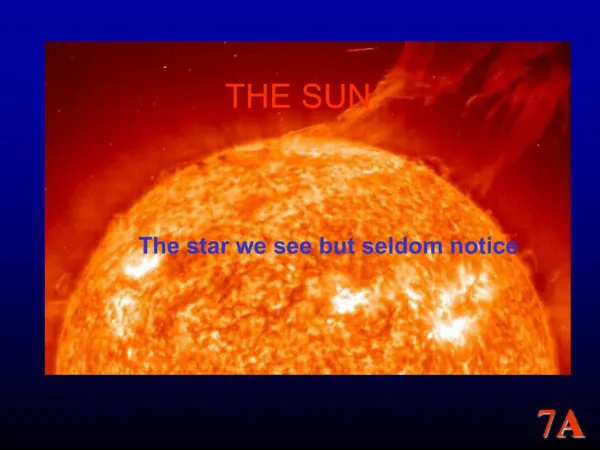
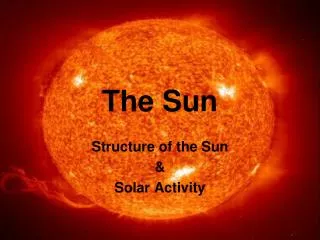
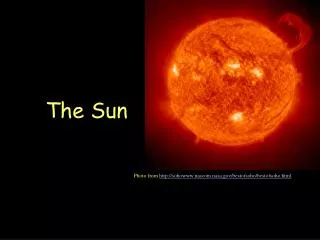
The Sun Photo from http://sohowww.nascom.nasa.gov/bestofsoho/bestofsoho.html
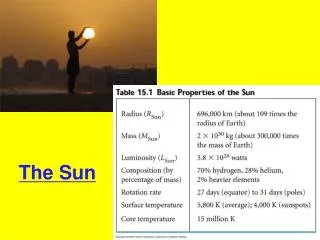
The Sun • Is a star • Made of gases • Is our primary source of energy 70% hydrogen and 28% helium Light (radiation) Image at http://science.nasa.gov/headlines/y2007/images/chromosphere/LimbFlareJan12_strip2.jpg
How Big is the Sun? About 110 times wider than Earth Or 1.3 million times bigger than Earth Photo from http://sohowww.nascom.nasa.gov/bestofsoho/bestofsoho.html
How does our Sun compare to other Stars? Our Sun is a dwarf—medium mass • Active stars range in size from supergiants to dwarfs • Stars range from very bright (supergiants) to very dim (dwarfs) • Stars range from very hot blue on the outside (O class) to cool red on the outside (M class) Our Sun is a medium-bright dwarf Our Sun is in-between--yellow
Rotation At the equator, the Sun rotates once every 25.4 days Near its poles, the Sun rotates once every 36 days Known as “differential rotation”
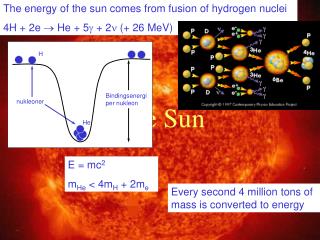
Energy from the Sun • Nuclear chain reaction (hydrogen forming helium) • Releases radiation (gamma rays) • The gamma ray loses energy as it bounces around inside the Sun • It is finally released at the photosphere, primarily as visible light Image at http://solarscience.msfc.nasa.gov/interior.shtml
Inside the Sun • Core • Radiative Zone • Convection zone Image at http://solarscience.msfc.nasa.gov/interior.shtml
The Sun’s Atmosphere • Photosphere • Chromosphere • Corona Photosphere image: http://science.msfc.nasa.gov/ssl/pad/solar/surface.htm Chromosphere image: http://science.msfc.nasa.gov/ssl/pad/solar/chromos.htm Corona image: http://solarsystem.nasa.gov/multimedia/display.cfm?IM_ID=191
The Photosphere • Photosphere: The ‘Surface’ of the Sun, and the layer from which light is given off • Sunspots: areas of the sun that look dark due to being cooler
Chromosphere & Corona • Chromosphere: middle layer of the Sun’s atmosphere • Corona: Largest layer of the Sun’s atmosphere
Solar Wind • Blows charged particles and magnetic fields away from the Sun • Charged particles captured by Earth’s magnetic field • Create Auroras or Northern and Southern Lights Image at http://solarscience.msfc.nasa.gov/the_key.shtml
Coronal Mass Ejection CMEs: large amount of electrically-charged gas are ejected suddenly from the Sun’s corona CMEs can damage satellites and interfere with radio and power distribution equipment
Prominences and Flares • Prominences- huge arching columns of gas • Flares: when gases near a sunspot brighten shooting outward
Radiation • Our Sun (and all active stars) emits radiation • Radio, infrared, visible, ultraviolet, x-ray and even some gamma rays • Most of the sunlight is yellow-green visible light or close to it The Sun at X-ray wavelengths Image and info at http://imagine.gsfc.nasa.gov/docs/teachers/gammaraybursts/imagine/page18.html and http://starchild.gsfc.nasa.gov/docs/StarChild/solar_system_level2/sun.html .
Sun as a Source of Energy • Light from the Sun is absorbed by the Earth, unevenly to: • drive wind bands – which drive surface currents • drive deep ocean currents • drive water cycle • drive weather Credit: NASA GSFC Water and Energy Cycle http://www.nasa.gov/centers/jpl/news/grace-20061212.html NASA image at http://visibleearth.nasa.gov/view_rec.php?id=107
Our Sun is a Regular/ Small Star Image at http://www.gsfc.nasa.gov/topstory/20011210insidesun.html
Stars begin as a cloud of gas and dust called nebula Image at http://hubblesite.org/newscenter/archive/releases/2007/04/image/a/results/50/
Main Sequence Over the course of millions of years, these protostars settle down into a state of equilibrium, becoming what is known as a main-sequence star Image at http://hubblesite.org/newscenter/archive/releases/1997/26/image/a/
After billions of years a Main sequence star will turn into a Red Giant
By 5 billion years… White Dwarf:This happens when all that is left is the hot dense core Image at http://hubblesite.org/newscenter/archive/releases/nebula/planetary/1998/39/results/50/
Supergiant's and Supernovas Supergiant's: Extremely large (and unstable red giants Supernovas: The explosion that occurs when the supergiant’s core collapses Image at http://hubblesite.org/newscenter/archive/releases/nebula/planetary/2000/28/image/a/format/web_print/results/50/
Black Hole • If the remaining dense core from a supernova collapses to a point • The gravity from this point is so strong that nothing can escape from it not even light. • If you were to shine a light into a black hole the light would simply disappear