Comprehensive Analysis of 2D Complex Wavelet Transform and Quantum Wavelet Transform for Image Processing
100 likes | 210 Views
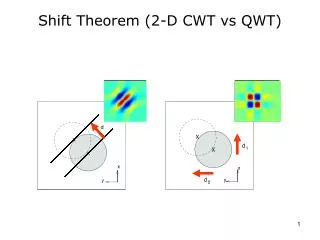
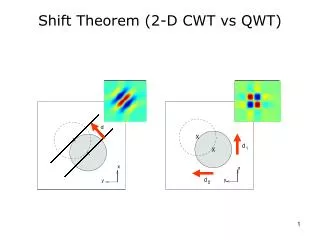
Compare and analyze the applications and properties of 2D complex wavelet transform and quantum wavelet transform for image processing. Explore the shift theorem, different subbands, and challenges in coherent processing. Study the phase angles and energy ratios to understand texture analysis.


Comprehensive Analysis of 2D Complex Wavelet Transform and Quantum Wavelet Transform for Image Processing
E N D
Presentation Transcript
+1 +1 +j -j +1 +1 +j -j +1 -1 -j -j -1 +1 +j +j 2-D Hilbert Transform (wavelet) Hx Hy Hy +j +1 -j +1 +j +1 -j +1 Hx
+1 -j +1 +j +1 +j +1 -j +1 -j +1 +j -j +1 +1 +j 2-D complex wavelet • 2-D CWT basis functions 45 degree -45 degree
Complex Wavelets 2-D CWT [Kingsbury,Selesnick,...] • Other subbands for LH and HL (equation) • Six directional subbands (15,45,75 degrees)
Challenge in Coherent Processing – phase wrap-around y x QFT phase where
QWT of real signals • QFT Plancharel Theorem: real window where • QFT inner product • Proof uses QFT convolution Theorem
v LH subband HH subband HL subband u QWT as Local QFT Analysis • For quaternion basis function : quaternion bases where • Single-quadrant QFT • inner product
QWT Edge response v QWT basis • Edge QFT: u QFT spectrum of edge • QFT inner product with QWT bases • Spectral center:
QWT Phase for Edges • Behavior of third phase angle: • denotes energy ratio between positive and leakage quadrant • Frequency leakage / aliasing • Shift theorem unaffected v positive quadrant S1 u leakage quadrant leakage
QWT Third Phase • Behavior of third phase angle • Mixing of signal orientations • Texture analysis