TAT and Sentence Completion Tests
140 likes | 321 Views
TAT and Sentence Completion Tests. Strengths of Sentence Completion Tests. Open-ended, free response Easily administered, brief Engaging for client Purpose disguised, some projection Can develop special purpose tests Can become part of clinical interview (maybe most common use).


TAT and Sentence Completion Tests
E N D
Presentation Transcript
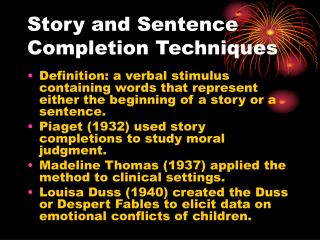
Strengths of Sentence Completion Tests • Open-ended, free response • Easily administered, brief • Engaging for client • Purpose disguised, some projection • Can develop special purpose tests • Can become part of clinical interview (maybe most common use)
Limitations of Sentence Completion Tests • Low reliability, validity (ISB is a possible exception) • Response styles play a strong role • Interpretation may be time-consuming • Requires literate client • Limited incremental validity of screener
Rotter’s Incomplete Sentences Blank (ISB) • 40 items with short stems • Takes about 20 minutes, easy to administer • Has a scoring manual with scoring criteria • Acceptable reliability • Cutoff of 135 for maladjustment
Scoring the ISB 6. Severe conflict: suicidal, severe family probs, strong neg attitudes, bizarre 5. Moderate conflict: inferiority, generalized social difficulty, psychosomatic complaints, concern over failure. 4. Mild conflict: specific c., not deep-seated or incapacitating. 3. Neutral: neither + or -. Lacking emotion or personal reference. 2. Specific positive: + attitude toward spec. things (e.g., school, hobbies) and general warm feelings toward others. 1. General positive: gen + feelings, optimism, humor, social adjustment 0. Very positive: clear and intense humor, optimism, acceptance of others.
TAT: Description and Administration • A set of 31 somewhat ambiguous black-and white illustrations • Up to 20 cards are selected for presentation, based on client’s age and gender • Client is instructed to create a story that describes: • What are they doing? • What happened before? • What are they thinking and feeling? • What will be the outcome? • Client’s stories are recorded verbatim
TAT: Strengths • Richness of personality description • Reflects current concerns • Describes interpersonal issues, patterns, motivations • Taps unconscious material
TAT: Limitations • Questionable reliability and validity • No standardization • Multiple scoring systems • Time-consuming • Relies on clinical intuition • Little known cross-culturally
TAT Stories: Some Assumptions • Storyteller ordinarily identifies with a person in the story. • The storyteller’s dispositions, strivings and conflicts are sometimes represented symbolically. • All stories are not of equal importance. • Themes that arise directly out of card are less significant than those which are more indirect. • Recurrent themes are most important.
TAT Interpretation • Multiple scoring systems, none standard (Murray’s is too cumbersome) • Interpretation relies on clinical skill and intuition of the tester. • Considerations: • Do stories coincide with typical themes? • Conformity with instructions • Repetition/intensity of themes • Sequence of themes (perseveration) • Psychodynamic content • Conflicts
TAT: Lilienfeld et al Critique • Different stimulus sets limit generalizability • Multiple scoring systems • Limited incremental validity • Validity results from different systems are equivocal • No norms available • It doesn’t matter: clinicians use intuitive systems anyway