Download
1 / 7
70 likes | 199 Views
This discourse examines two profound questions: Can a person continue to exist after death, and what defines personal identity over time? The traditional view links personal identity to bodily existence, suggesting cessation upon death. Alternatively, if identity resides in the continuity of the soul or mind, existence beyond death is conceivable. Key distinctions are made between numerical and qualitative identity, emphasizing that personal identity allows for regret and anticipation of future events. The dialogue critiques the soul-centric view and questions the criteria for judgment of personal identity, advocating for a deeper understanding of what makes us persist as the same individual.

E N D
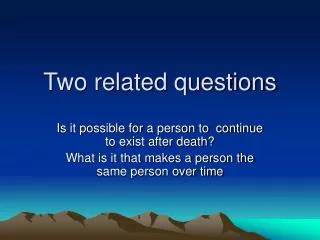
Two related questions Is it possible for a person to continue to exist after death? What is it that makes a person the same person over time
The first question is more fundamental If we take personal identity to consist in bodily identity, then it seems that we must cease to exist when the body ceases to exist If we think personal identity consists in the continuity of the soul or mind, then continuation after death is possible
A crucial distinction • People sometimes use the word “identical” to mean qualitatively identical. (Joe and Bob and identical twins • Personal identity has to do with numerical identity. What makes me the same person over time, not what makes me similar over time
Personal identity Is presupposed in anticipation and regret • If I regret what I did yesterday, this only makes sense if it was ME, not someone else, who did the regretful thing • When I plan for the future, anticipate going to a party or getting married, these thoughts pressupose that I persist, that I am the one who is going to the party etc.
Sam: personal identity consists in sameness of souls. So there is no problem with Gretchen continuing to exist after death, since her soul is not her body and need not die with it. • Gretchen criticizes this soul view.
Gretchen: We make judgements of personal identity all the time. • But we do not make judgements about souls. • Souls are not perceivable, so how can they be what ground our judgements of personal identity.
The soul flow argument • It is possible that my soul is replaced at any random interval, and I would not notice. There seem to be no criteria for determining whether I have the same soul, or a different, similar soul. • But I can judge that I am the same person • Therefore souls are not what account for personal identity