Loop Parallelism and OpenMP CS433 Spring 2001
70 likes | 197 Views
Loop Parallelism and OpenMP CS433 Spring 2001. Laxmikant Kale. Loop parallelism. Observation: Most programs that need to be parallelized derive their complexity (in terms of the number of operations executed) from iterative behavior, expressed in loops


Loop Parallelism and OpenMP CS433 Spring 2001
E N D
Presentation Transcript
Loop Parallelism and OpenMPCS433Spring 2001 Laxmikant Kale
Loop parallelism • Observation: • Most programs that need to be parallelized derive their complexity (in terms of the number of operations executed) from iterative behavior, expressed in loops • If we can execute multiple iterations of a loop in parallel… • We can often, indeed, do that • What are the conditions? • Sometimes, the code needs a bit of restructuring • Several research efforts • Also, automating the parallelization of loops via compilers • But that is not our focus in this lecture
OpenMP evolution • Standardization effort: • Included shared memory programming as well • I.e. subsumes Pthreads • Involves many vendors: • Intel, SGI, HP, DEC/Compaq, .. • Language bindings: • Fortran, C, C++
Overview • Basic view: • The program is single threaded, but it spawns parallel subtasks (threads) once in a while • Note the distinction with Pthreads model • There, each thread could be executing completely different code • But typically, it doesn’t • Parallel threads • Worksharing: • parallel loops • sections • Shared variables: • shared, private, firstprivate, lastprivate, ..
Spawning threads • Executes a section of code, by spawning multiple threads to execute it. • Each thread gets a copy of all private variables • Separate from the “main program”’s copy • (so, there are k+1 copies if there are k threads fired) • Threads may uses locks and barriers • calls are different than PThreads double A[1000]; omp_set_num_threads(4); #pragma omp parallel { int ID = omp_thread_num(); pooh(ID,A); } Some Example/s from sc99 Tutorial at OpenMP web site.
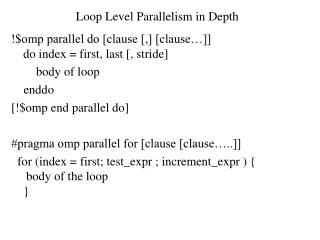
Work-sharing: for construct • Do all the iterations of a loop in parallel • We will use Prof. Padua’s slides for this • Not just the syntax and semantics of the parallel loop construct • But how to write code, by transforming sequential loops, so they are parallel • Slides 20-45 (Section 4.1 to 4.4), and 55-59 (4.7) • Also read the OpenMP C manual • http://polaris.cs.uiuc.edu/~padua/cs320 • http://polaris.cs.uiuc.edu/~padua/cs320/guidec.pdf #pragma omp parallel #pragma omp for schedule(static) for(i=0;I<N;i++) { a[i] = a[i] + b[i];}
Work-sharing: Sections • Parallel Loops allow identical sections of code (with different loop indices) to execute in parallel • Sections allow different sections of code to be run by parallel threads #pragma omp parallel #pragma omp sections { X_calculation(); #pragma omp section y_calculation(); #pragma omp section z_calculation(); }