Download
1 / 10
100 likes | 234 Views
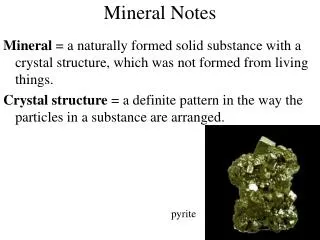
This review covers fundamental minerals essential for testing, providing crucial properties to recognize. Each mineral sample features its hardness, streak color, breakage type, and luster, with unique notes enhancing identification skills. For example, you'll learn how quartz appears as a colorless, nonmetallic crystal, while pyrite exhibits a green-black metallic look. The review culminates with a key to the mineral identities at the end—no peeking! Prepare effectively by understanding each mineral's characteristics and improve your test performance.

E N D
The following is a review of the important minerals you will need to know for the test. The identity of the minerals are given at the end of the PowerPoint. No peeking!
SAMPLE #1 Harness: 7 Streak: colorless Breakage: fracture Luster: nonmetallic (glassy) Special notes: this is a six-sided crystal with hexagonal symmetry Fractured part of the sample.
SAMPLE #2 Harness: 6.5 Streak: green-black Breakage: fracture Luster: metallic
SAMPLE #3 Harness: 2.5-3 Streak: black to dark brown Breakage: cleavage Luster: nonmetallic
SAMPLE #4 Harness: 3 Streak: colorless Breakage: cleavage Luster: nonmetallic (glassy) Special notes: mineral will react (fizz) with acid and mineral always has the shape of a rhombus
SAMPLE #5 Harness: 2.5 Streak: gray-black streak Breakage: cleavage Luster: metallic
Answer key • Sample 1: quartz • Sample 2: pyrite • Sample 3: biotite mica • Sample 4: calcite • Sample 5: galena
FOR FUN – answer on next slide! Harness: 2.5-3 Streak: red-orange Breakage: fracture Luster: metallic