Understanding Continuous and Discrete-Time Signals: Concepts and Transformations
This lecture delves into the fundamental distinctions between continuous and discrete-time signals, clarifying the differences between discrete and digital signals. It covers essential concepts such as transformation of the independent axis, time shifting, time reversal, and time scaling, alongside practical examples including speech, video, and demographic data. The session also discusses continuous and discrete-time systems, showcasing examples like the squaring system and differentiator system. Emphasis is placed on understanding when and why to discretize signals, along with notations for representing these signals.

Understanding Continuous and Discrete-Time Signals: Concepts and Transformations
E N D
Presentation Transcript
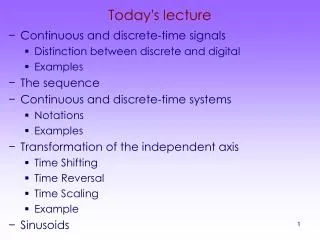
Today's lecture • Continuous and discrete-time signals • Distinction between discrete and digital • Examples • The sequence • Continuous and discrete-time systems • Notations • Examples • Transformation of the independent axis • Time Shifting • Time Reversal • Time Scaling • Example • Sinusoids
Continuous-time signals • A value of signal exists at every instant of time Independent variable Independent variable
Discrete-time signals • The value of signal exists only at equally spaced discrete points in time Independent variable Independent variable
Discrete-time signals • Why to discretize • How to discretize • How closely spaced are the samples • Distinction between discrete & digital signals • How to denote discrete signals • Is the image a discrete or continuous signal • The image is generally considered to be a continuous variable • Sampling can however be used to obtain a discrete, two dimensional signal (sampled image)
Continuous and discrete signals • A continuous-time signal is represented by enclosing the independent variable (time) in parentheses () • A discrete-time signal is represented by enclosing the independent variable (index) in square brackets []
Continuous and discrete signals • Examples of continuous signals • Speech, video, image • The variation of atmospheric pressure, wind speed and temperature with altitude • Examples of discrete signal • Demographic data, weekly stock position of a company
Continuous and discrete time system • Like signals we have continuous and discrete-time systems as well system system
Continuous and discrete time system • Examples of continuous and discrete-time systems Squaring System Differentiator System Accumulator System
Transformations • Transformations of the independent variable • Time Shift
Transformations • Time reversal
Transformations • Time scaling
Transformations • Example
Sinusoidal signals • x(t) = A cos(ωt + Φ) • A is the maximum amplitude of the sinusoidal signal • ω is the radian frequency • is the phase shift