Download
1 / 19
190 likes | 326 Views
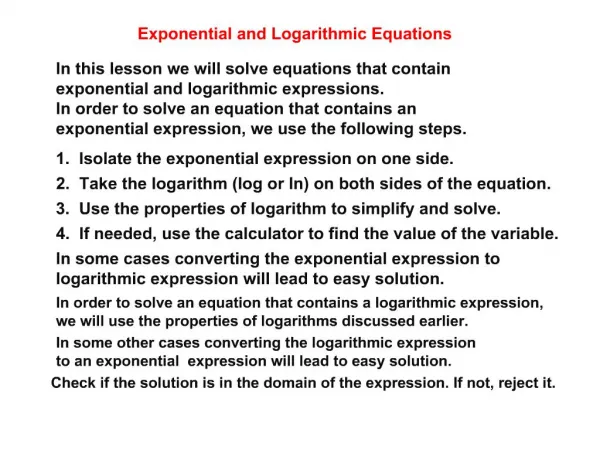
This text outlines methods for solving exponential and logarithmic equations. It explains the property that if two exponential expressions with the same base are equal, their exponents must also be equal. The document provides step-by-step examples, including rewriting equations with the same base and utilizing logarithms when necessary. Additionally, it covers Newton’s Law of Cooling and demonstrates finding the time required for a substance to cool to a desired temperature. This comprehensive guide is essential for mastering exponential and logarithmic equations.

E N D
Exponential Equations • One way to solve exponential equations is to use the property that if 2 powers w/ the same base are equal, then their exponents are equal. • For b>0 & b≠1 if bx = by, then x=y
Solve by equating exponents • 43x = 8x+1 • (22)3x = (23)x+1 rewrite w/ same base • 26x = 23x+3 • 6x = 3x+3 • x = 1 Check → 43*1 = 81+1 64 = 64
Your turn! • 24x = 32x-1 • 24x = (25)x-1 • 4x = 5x-5 • 5 = x Be sure to check your answer!!!
When you can’t rewrite using the same base, you can solve by taking a log of both sides • 2x = 7 • log22x = log27 • x = log27 • x = ≈ 2.807
4x = 15 • log44x = log415 • x = log415 = log15/log4 • ≈ 1.95
102x-3+4 = 21 • -4 -4 • 102x-3 = 17 • log10102x-3 = log1017 • 2x-3 = log 17 • 2x = 3 + log17 • x = ½(3 + log17) • ≈ 2.115
5x+2 + 3 = 25 • 5x+2 = 22 • log55x+2 = log522 • x+2 = log522 • x = (log522) – 2 • = (log22/log5) – 2 • ≈ -.079
Newton’s Law of Cooling • The temperature T of a cooling substance @ time t (in minutes) is: • T = (T0 – TR) e-rt + TR • T0= initial temperature • TR= room temperature • r = constant cooling rate of the substance
You’re cooking stew. When you take it off the stove the temp. is 212°F. The room temp. is 70°F and the cooling rate of the stew is r =.046. How long will it take to cool the stew to a serving temp. of 100°?
T0 = 212, TR = 70, T = 100 r = .046 • So solve: • 100 = (212 – 70)e-.046t +70 • 30 = 142e-.046t (subtract 70) • .221 ≈ e-.046t (divide by 142) • How do you get the variable out of the exponent?
Cooling cont. • ln .221 ≈ ln e-.046t(take the ln of both sides) • ln .221 ≈ -.046t • -1.556 ≈ -.046t • 33.8 ≈ t • about 34 minutes to cool!
Solving Log Equations • To solve use the property for logs w/ the same base: • + #’s b,x,y & b≠1 • If logbx = logby, then x = y
log3(5x-1) = log3(x+7) • 5x – 1 = x + 7 • 5x = x + 8 • 4x = 8 • x = 2 and check • log3(5*2-1) = log3(2+7) • log39 = log39
When you can’t rewrite both sides as logs w/ the same base exponentiate each side • b>0 & b≠1 • if x = y, then bx = by
log5(3x + 1) = 2 • 5log5(3x+1) = 52 • 3x+1 = 25 • x = 8 and check • Because the domain of log functions doesn’t include all reals, you should check for extraneous solutions
log5x + log(x+1)=2 • log (5x)(x+1) = 2 (product property) • log (5x2 – 5x) = 2 • 10log5x -5x = 102 • 5x2 - 5x = 100 • x2 – x - 20 = 0 (subtract 100 and divide by 5) • (x-5)(x+4) = 0 x=5, x=-4 • graph and you’ll see 5=x is the only solution 2
One More!log2x + log2(x-7) = 3 • log2x(x-7) = 3 • log2 (x2- 7x) = 3 • 2log2x -7x = 32 • x2 – 7x = 8 • x2 – 7x – 8 = 0 • (x-8)(x+1)=0 • x=8 x= -1 2