Ionization Energy
Ionization Energy. Esther Jun, Claire Lee, and Eunhye Oak. What do those spikes mean???. Definition. Ionization energy is the energy required to REMOVE an electron from an atom in the gas phase Atom in ground state (g) Atom + (g) + e -

Ionization Energy
E N D
Presentation Transcript
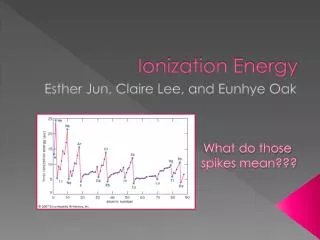
Ionization Energy Esther Jun, Claire Lee, and Eunhye Oak What do those spikes mean???
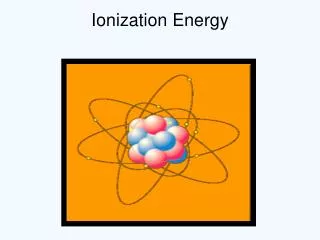
Definition • Ionization energy is the energy required to REMOVE an electron from an atom in the gas phase • Atom in ground state(g) Atom+(g) + e- • Always positive values measured in kJ/mol or eV/atom • Besides hydrogen, atoms have a series of ionization energies because more than one electron can be removed
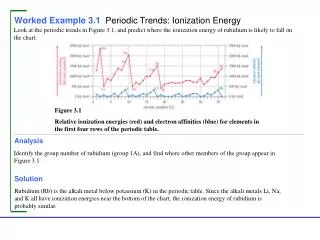
Group Trends • First ionization energies generally DECREASE down a column Group showing off trends.
Explanation for Trend • The electron removed is increasingly farther from the nucleus, thus reducing the nucleus- electron attractive force
A Deeper Explanation • Inner electrons at lower energy levels "shield" the valence electrons from the nucleus’s force of attraction (Z*- effective nuclear charge). • As each element of the group has more energy levels, the subshells decrease Z* for the electrons in the outer shell, making it easier to remove them.
Periodic Trends First ionization energies generally INCREASE left to right across a period
Explanation for Trend The number of protons increases from left to right; therefore, the Z* (effective nuclear charge) is greater to the right of a period. The electron experiences a greater electrostatic attraction to the nucleus, and as a result, more energy is needed to remove it.
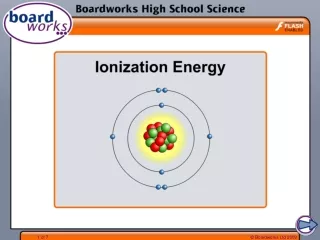
Although inaccurate, the Bohr model serves as a good visual.
Exceptions to the trend(First Ionization Energy) • First ionization energies from left to right across this period generally increases. • But Boron and Oxygen don’t follow this trend! Why?
Exceptions to the trend(First Ionization Energy) • Be: [He] 2s2 vs. B: [He] 2s22p1 • When Boron is ionized, a 2p electron (slightly higher energy with smaller Z*) is removed, requiring less energy • This small “dip” in the increasing trend occurs between the other Group 2A and Group 3A elements
Exceptions to the trend(First Ionization Energy) • Oxygen’s first ionization energy < Nitrogen • Electrons are assigned to separate p-orbitals (minimizing the force of repulsion) in elements of Group 3A~5A, like nitrogen • In elements of Group 6A, such as oxygen, the paired electrons increase repulsion, leading for easier removal • But beyond the first pair, Z* outweighs electron repulsion and the increasing trend continues for Group 7A and on
Second, Third, Fourth ionization energies… and beyond! • Elements form ions with different charges because of ionization energies! • Notice the huge differences between the first and second IE’s of Na, the second and third IE’s of Mg, and so on
Second, Third, Fourth ionization energies… and beyond! • Removing the one electron from Na’s 3s-orbital doesn’t require much energy, but breaking into the filled 2p-orbital will require much, much more! • The same huge jump occurs after removing the 3s2 electrons from Mg and the 3s2 and 3p1 electrons from Al • The enormous gap between higher ionization energies explains why Main Group element ions have the same charge as you go down the group