Heating Water and Ice: Energy Calculations for Temperature Changes and Phase Transitions
This article explores the energy dynamics involved in heating water and ice through various temperature changes and phase transitions. We analyze three scenarios: heating 100 g of liquid water from 1.0˚C to 111˚C and calculating the energy added, heating solid water from -10.0˚C with 73.1 kJ of heat to find the final temperature, and examining the steam transformation process when 171 kJ of heat is added to water at 70.0˚C. The calculations utilize specific heat capacities and heat of fusion/vaporization to understand energy transfers.

Heating Water and Ice: Energy Calculations for Temperature Changes and Phase Transitions
E N D
Presentation Transcript
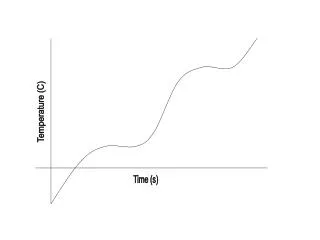
Temperature (C) Time (s)
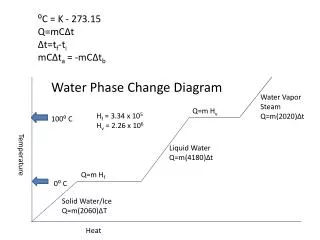
Crossing the Line… 100.0 g of liquid water is heated from 1.0˚C to 111˚C. How much energy was added to the water to cause this temperature change? Cice = 2.1 J/g˚C Hfusion = 334 J/g Cwater =4.2 J/g˚C Hvap = 2260 J/g Csteam = 31.3J/g˚C
Crossing the Line Again… 100.0 g of solid water is heated from -10.0˚C to some new temp. If 73.1 kJ of heat are added to the ice, what is the final temperature of the resulting material? Cice = 2.1 J/g˚C Hfusion = 334 J/g Cwater =4.2 J/g˚C Hvap = 2260 J/g Csteam = 31.3J/g˚C
Crossing the Line One Last Time… 100.0 g of water at 70.0˚C is heated with a burner. If 171 kJ of heat are added to the water, what percentage of the water turns to steam? Cice = 2.1 J/g˚C Hfusion = 334 J/g Cwater =4.2 J/g˚C Hvap = 2260 J/g Csteam = 31.3J/g˚C