Exploring Phototransduction: Insights from Drosophila's Compound Eyes
This paper delves into the complex mechanisms of phototransduction in Drosophila, centering on the comparative analysis of insect and vertebrate systems. It covers the molecular mechanisms, phenomenological modeling, and predictions based on experimental comparisons. Key topics include the response of fly photoreceptors to light, the role of signaling molecules, and the dynamics of calcium influx. Overall, the study aims to enhance our understanding of phototransduction limits and the advantages of using Drosophila as a model organism in neuroscience and systems biology.


Exploring Phototransduction: Insights from Drosophila's Compound Eyes
E N D
Presentation Transcript
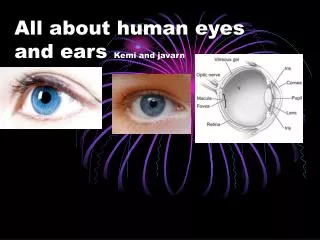
Eyes everywhere… Copepod's 2 lens telescope Scallop Trilobite fossil 500 million years House Fly Black ant Octopus Cuttlefish
Modeling fly phototransduction:how quantitative can one get?
Limits of modeling? Comparative systems biology? • vertebrate phototransduction (rods, cones) • insect phototransduction • olfaction, taste, etc…
Fly photo-transduction Outline: • About the phenomenon • Molecular mechanism • Phenomenological Model • Predictions and comparisons with • experiment.
Fly photoreceptor cell Microvillus hv Na+, Ca2+ Rhodopsin 50nm 1.5 mm
Single photon response in Drosophila: a Quantum Bump “All-or-none” response Low light Henderson and Hardie, J.Physiol. (2000) 524, 179 Dim flash
Comparison of a fly with a toad. Single photon response: Note different scales directions of current!! From Hardie and Raghu, Nature 413, (2001)
Linearity of macroscopic response hv Linear summation over microvillae
Average QB wave-form QB aligned at tmax Henderson and Hardie, J.Physiol. (2000) 524, 179 A miracle fit:
Latency distribution # of events Latency (ms) QB variability # events Peak current Jmax (pA)
Multi-photon response Macroscopic response = average QB Convolution with latency distribution QB waveform Latency distribution determines the average macroscopic response !!! Fluctuations control the mean !!!
Advantages of Drosophila photo-transduction as a model signaling system: • Input: Photons • Output: Changes in membrane potential • Single receptor cell preps • Drosophila genetics
Gabg * * * GDP Ga IP3 + DAG PLCb PKC Rh Rh DAG hv GTP GDP GTP Trp Na+, Ca++ Trp* Ca pump Response initiation High [Na+], [Ca++] PIP2 Low [Na+], [Ca++] DAG Kinase Cast: Rh = Rhodopsin; Gabg = G-protein PIP2 = phosphatidyl inositol-bi-phosphate DAG = diacyl glycerol PLCb = Phospholipase C -beta ; TRP = Transient Receptor Potential Channel
High [Ca++] Gabg GDP PIP2 IP3 + DAG PLCb PKC * * * Rh Ga DAG hv GTP Trp* GTP GDP Trp Na+, Ca++ Intermediate [Ca++] Positive Feedback Ca pump Intermediate [Ca] facilitates opening of Trp channels and accelerates Ca influx.
Gabg GDP PIP2 IP3 + DAG PLCb * * * Ga * * GTP Arr Trp* GTP GDP ?? Cam Negative feedback and inactivation High [Ca++] Rh* PKC Na+, Ca++ High [Ca++] Ca pump Cast: Ca++ acting directly and indirectly e.g. via PKC = Protein Kinase C and Cam = Calmodulin Arr = Arrestin (inactivates Rh* )
Comparison of early steps Vertebrate Drosophila 2nd messengers DAG cGMP From Hardie and Raghu, Nature 413, (2001)
…and another cartoon c. a. d b. From Hardie and Raghu, Nature 413, (2001)
InaD signaling complex InaD PDZ domain scaffold From Hardie and Raghu, Nature 413, (2001)
Speed and space: the issue of localization and confinement. Order of magnitude estimate of activation rates: PLC* ~ k [G] ~ 10mm2/s 100 / .3 mm2 > 1 ms-1 G* ~ ! Fast Enough ! Diffusion limit on reaction rate Protein (areal) density However if: ~ 1mm2/s 10 / .3 mm2 =.03ms-1 << 1 ms-1 ! Too Slow ! Possible role for InaD scaffold !
A naïve model low “Input” Ca2+ TRP channel ( G*, PLCb*, DAG) high
Kinetic equations: Activation stage ( G-protein; PLCb; DAG ): Input (Rh activity) QB “generator” stage ( Trp, Ca++ ): Positive and negative feedback # open channels Ca++ influx via Trp* Ca++ outflow/pump
Feedback Parameterization Parameterized by the “strength”ga(~ ratio at high/low [Ca]) Characteristic concentration KDa and Hill constant ma Note: this has assumed that feedback in instantaneous…
A=.2 Trp*/Trp .05 .03 A=.02 [Ca]/[Ca0] Null-clines and fixed points [Ca]=0 [TRP*]=0 null-cline
Problems with the simple model Experiment Model “High” fixed point • In response to a step of Rh* activity (e.g. in Arr mutant ) • QB current relaxes to zero • Ca dynamics is fast rather than slow no “overshoot” • Long latency is observed
Order of magnitude estimate of Ca fluxes [Ca]dark ~ .2mM 1 Ca ion / microvillus [Ca]peak ~ 200mM 1000 Ca ion / microvillus Note: m-villus volume ~ 5*10-12 ml Influx 104 Ca2+ / ms 30% of 10pA Hence, Ca is being pumped out very fast ~ 10 ms-1 [Ca] is in a quasi-equilibrium
Microvillus as a Ca compartment Ca++ 50nm 1-2 um Compare 10 ms-1 with diffusion rate across the microvillus: t -1 ~ Dca / d2 ~ 1mm2/ms / .0025 mm2 = 400 ms -1 But diffusion along the microvillus: is too slow compared to 10ms-1 t -1 ~ 1mm2/ms / 1 mm2 = 1 ms -1 Hence it is decoupled from the cell. Note: microvillae could not be > .3mm in diameter, i.e it is possible the diameter is set by diffusion limit
Slow negative feedback Assume negative feedback is mediated by a Ca-binding protein (e.g. Calmodulin??) Slow relaxation
A more ‘biochemically correct’ model: Cascade Feedback F+ F- Delayed Ca negative feedback
Stochastic effects Numbers of active molecules are small ! e.g. 1 Rh*, 1-10 G* & PLC*, 10-20 Trp* Chemical kinetics Reaction “shot” noise. Master equation Numerical simulation Gillespie, 1976, J. Comp. Phys. 22, 403-434 see also Bort,Kalos and Lebowitz, 1975, J. Comp. Phys. 17, 10-18
Stochastic simulation Event driven Monte-Carlo simulation a.k.a. Gillespie algorithm Gillespie, 1976, J. Comp. Phys. 22, 403-434 see also Bort,Kalos and Lebowitz, 1975, J. Comp. Phys. 17, 10-18 Numbers of molecules (of each flavor) #Xa(t) are updated #Xa(t) #Xa(t) +/- 1 at times ta,i distributed according to independent Poisson processes with transition rates Ga,+/- . Simulation picks the next “event” among all possible reactions. Note: simulation becomes very slow if some of the Reactions are much faster then others. Use a “hybrid” method.
The model is phenomenological… Many (most?) details are unknown: e.g. Trp activation may not be directly by DAG, but via its breakdown products; Molecular details of Ca-dependent feedback(s) are not known; etc, etc BUT there’s much to be explained on a qualitative and quantitative level…
Identifying “submodules” Cascade Key dynamical variables define “Submodules” Feedback F+ F- Delayed Ca negative feedback
Rephrased in a “Modular” form: the “ABC model” Activator – Buffer – Ca-channel Ca++ (PLCb*, Dag) “Input” Activator Channel (TRP) ( Rh*, G*) Ca++ B (Ca-dependent inhibition)
Quantum Bump generation (A,B) - “phase” plane High probability of TRP channel opening 180 TRP* 140 A 100 PLC* B*/10 60 A 20 0 200 400 600 B* “INTEGRATE & FIRE” process Threshold for QB generation
C 0 1 2 3 4 B What about null-cline analysis? Problems: • 3 variables A,B,C • Stochasticity • Discreteness Generalized “Stochastic Null-cline” “Ghost” fixed point
Can one calculate anything? E.g. estimate the threshold for QB generation: PLC* PLC* A-1 A A+1 Positive feedback kicks in once channels open Am Am f([Ca]) C = 0 1 2 Threshold A = AT such that Prob (AT -> AT +1) = Prob (C=0 -> C=1) NOTE: Better still to formulate as a “first passage” problem
Condition for QB generation Prob (C=1 C=2) > Prob (C=1 C=0) AT > AQB ([Ca]) Reliable QB generation AT Amax~ PLC* PLC* [Ca] * 4 3 AQB ([Ca]) 2 1 0 A [Ca] Bistable region/ Bimodal response
Quantum Bump theory versus reality Model Experiment Latency histogram Average QB profile
Fitting the data: QB wave-form There is a manifold of parameter values providing good fit for < QB > shape !! Trp*/Trptot Time (arbs)
So what ??? “With 4 parameters I can fit an elephant and with 5 it will wiggle its trunk.” E. Wigner
Non-trivial “architectural” constraints • Despite multiplicity of fits, certain constraints emerge: • Trp activation must be cooperative • Activator intermediate must be relatively stable: • “integrate and fire” regime. • Negative feedback must be delayed • Multiple feedback loops are needed • Etc, … Furthermore: Fitting certain relation between parameters: “phenotypic manifold” - the manifold in parameter space corresponding to the same quantitative phenotype.
Constraining the parameter regime… Help from the data on G-protein hypomorph flies: • # of G-proteins reduced by ~100 • QB “yield” down by factor of 103 • Increased latency (5-fold) • Fully non-linear QB with amplitude reduced about two-fold
G-protein hypomorph Model: Experiment: • Single G* and PLC* can evoke a QB !! • Reduced yield explained by PLC* deactivating • before A reaches the QB threshold • Relation between yield reduction and • increased latency. # PLC* ~ 5 for WT
What happens in response to continuous activation ? e.g. if Rh* fails to deactivate
Persistent Rh* activity Relaxation Oscillator (A,B*) phase plane 180 Trp* 140 A 100 B* 60 20 A 100 200 300 400 500 B* Unstable Fixed Point
QB trains: theory versus experiment Arrestin mutant (deficient in Rh* inactivation): Model: Qualitative but not quantitative agreement so far…