Protists
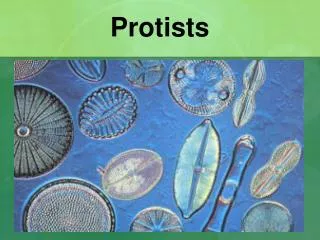
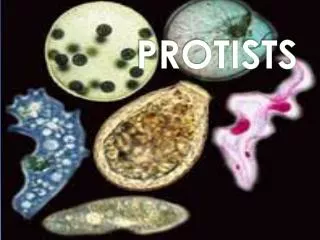
This overview covers the fascinating realm of protists, organisms primarily belonging to the Kingdom Protista, which comprises mostly unicellular eukaryotes. Their classification depends on nutrition and movement. We will study four types of protists: Amoeba, Paramecium, Euglena, and Volvox. Each has unique characteristics, such as Amoeba's pseudopodia for movement and Paramecium's cilia for ingestion. Additionally, Euglena displays both plant and animal traits, while Volvox forms colonies. Understanding these organisms enhances our knowledge of life's complexity.


Protists
E N D
Presentation Transcript
Protists October 31, 2012
A protist is…(write down the stuff in blue in your science notebook) • Protists belong to the Kingdom Protista, which includesmostlysingle-celled organisms that do not fit into the other kingdoms. Characteristics of Protists: • mostly unicellular, some are multicellular (algae) • most live in water (though some live in moist soil or even the human body) • ALL are eukaryotic (have a nucleus)
How are they classified? Protista = the very first Classification of Protists: • how they obtain nutrition (How they eat!) • how they move
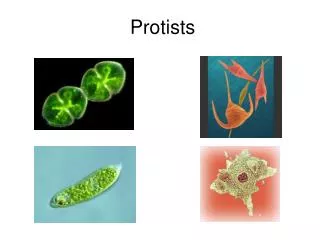
We will be studying 4 types of protists: • Amoeba • Paramecium • Euglena • Volvox
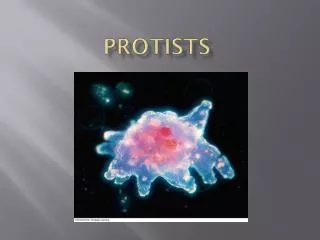
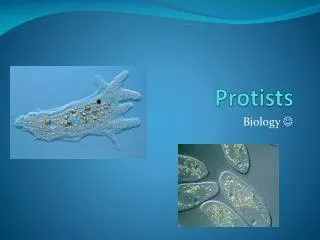
Amoeba • An amoeba Moves using “false feet” or pseudopodia • Eats food by surrounding and engulfing it • Does not make its own food (heterotroph) • Movie of an amoeba eating: http://www.youtube.com/watch?v=ojrkxmD6tT8 • Movie of an amoeba moving: http://www.youtube.com/watch?v=7pR7TNzJ_pA&feature=fvwp
Paramecium • Moves using hair-like Cilia • Has two nuclei • Ingests through a mouth pore • Stores food in food vacuole • Releases waste through an anal pore • Heterotroph like the amoeba • Paramecium moving & eating: http://www.youtube.com/watch?v=zS0f82ZJtvk&feature=related
Euglena • Characteristics of both plants & animals • Has chloroplasts to produce food through photosynthesis (autotrophic) • Has light sensitive eye spot • Can also surround & engulf food • Has whip-like flagellum for movement • Video of Euglena: http://www.youtube.com/watch?v=ZHZZKwrYm4g
Volvox • A type of algae • Actually form large spherical (like a ball) colonies of single-celled organisms • AS MANY AS 50,000 in one colony! • Although they are all individual organisms, they work together to act like one multicellular organism • Can digest food (heterotroph) as well as produce their own food through photosynthesis (autotroph) • Have flagellafor movement • http://www.youtube.com/watch?v=He9FSeGRi3A&feature=related
Test Corrections…Due WED! • Please make corrections on your test in a different color ink. • Turn it in for 10 additional points on your test. • I will give students a chance to retake the test in class. • Once again, it is due on WEDNESDAY.
3-2-1 Ticket out the Door • In your science notebook (remember…I am checking on Friday) please write down the following: 01/30/12 3 Things you Learned Today 2 Things you are still confused about 1 Thing you would like to know more about