Evolution Review
This review explores the fundamental principles of evolution, focusing on the philosophy of truth in science, the mechanisms of natural selection, and the processes by which species evolve over time. Key topics include the requirements for natural selection—variation, differential mortality, and heritability—and the types of evolution, such as speciation and modes like gradualism versus punctuated equilibrium. We dive into fossil formation, sedimentary geology, and the contributions of Charles Darwin. Prepare for an upcoming quiz with this comprehensive study guide!

Evolution Review
E N D
Presentation Transcript
Evolution Review Do Now: Turn in cladogram labs from yesterday
Part I: Phillosophy of Truth • What is science? • Observable, measurable quantities only! • Hypotheses require mechanisms (how) with supporting evidence • Truth and Logic in Science • Negative proof is impossible (Russell’s Teapot, Flying Spaghetti Monster) • Occam’s Razor: the least complex solution to a problem has the highest probability of being correct • Parsimony: measure of complexity. More parsimonious = simpiler.
Part II: Evolution Basics • Evolution: how species change over time. • Natural selection: the mechanism of evolution. • the process by which heritable traits that make it more likely for an organism to survive and successfully reproduce become more common in a population over successive generations.
Natural Selection • For natural selection to function, there are 3 requirements • Variation • Differential mortality • heritability
1: Variation • For natural selection to work, there must be a range of characteristics in a population.
2: Differential Mortality • Some characteristics or variations allow an organism to survive and/or reproduce more than others.
3: Heritability • The characteristics that lead to increased survival and reproduction must be able to be passed on to subsequent generations
Types of Evolution • Speciation: The evolution of new species from pre-existing ones • Two types of speciation • Phyletic speciation: One species replaces an older one (think fossils) • Divergent speciation: One species evolves into two new species.
2 Modes of Evolution • Gradual Evolution: small changes over long periods of time • Punctuated Equilibrium: big changes in short time periods.
Fossils • Fossil: preserved remains or traces of an ancient organism. • Most are formed by mineralization (turning to rock) • Trace fossil: not the organisms itself, but from an organism (dung, footprints, etc.) • Other fossils: amber, ice, tar
Fossil Geology • Sedimentary rock: rocks made of compressed layers of sediment. Only type of rocks that contain fossils
Fossil Geology • Law of Superposition: Older rocks are found below newer ones, since layers of sediment are deposited over time.
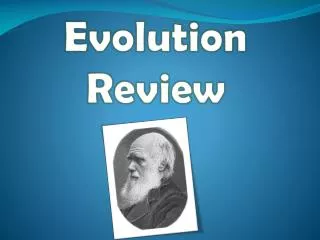
Darwin • Charles Darwin proposed the theory of evolution by natural selection in his 1859 book The Origin of Species. • His evidence came from an expedition around South America on the H.M.S. Beagle. • Most important to his work are the unique creatures of the Galapagos Islands
Representing Change • Phylogram (aka cladogram): A diagram representing evolutionary relationships.
Homologous Structures • Homologous structures are similar in form and composition in different species.
Phylogeny • Phylogeny is the relatedness among different species (note: phylogenetic tree shows phylogeny) • It is based on: • Fossil evidence • Homology (including genetics)
That’s Evolution Part 1! • BIG quiz tomorrow – study this guide!!!