Download
1 / 27
270 likes | 398 Views
This presentation explores TxLinux, an innovative transactional operating system designed to leverage Hardware Transactional Memory (HTM) for enhanced memory synchronization in multiprocessor architectures. It discusses fundamental concepts of transactions such as atomicity and serializability, evaluating their integration into Linux. Key architectural modifications, transaction management strategies, and performance evaluations are highlighted. The goal is to reduce programming complexity and improve system performance by utilizing transactional memory, addressing challenges like deadlocks and priority inversion.

E N D
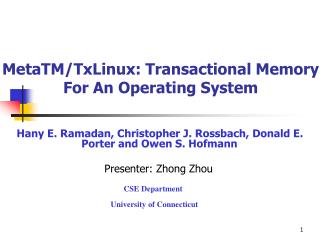
MetaTM/TxLinux: Transactional Memory For An Operating System Hany E. Ramadan, Christopher J. Rossbach, Donald E. Porter and Owen S. Hofmann Presenter: Zhong Zhou CSE Department University of Connecticut
Outline • Introduction & Background • Architectural Model • Interrupts and Transactions • Stack memory and Transactions • Modifying Linux to use HTM • Evaluation • Conclusions
Introduction • What is Transaction? A finite sequence of machine instructions, executed by a single process, satisfying the following two conditions • Serializability: transactions appear to execute serially, the steps of one transaction never appear to be interleaved with the steps of another. • Atomicity: each transaction makes a sequence of changes to shared memory, when it completes, it either commits, make all changes visible to others, or it abort, causing its changes to be discarded.
Transactional memory • A multiprocessor architecture for memory access synchronization as conventional mutual exclusion technique • Basic instruction for manipulating transaction status • Commit • Abort • Validate • Basic primitive instruction for accessing memory • Load transactional • Load transactional-exclusive • Store transactional
Why Transaction memory? • Problem with Lock-based code • Deadlock • Convoying • Priority inversion • Transaction memory: Reduce programming complexity without sacrificing performance • STM: software transaction memory • HTM: hardware transaction memory
Main Contribution • Examination of the architectural support necessary for an operation system to use HTM • Creation of a transactional operating system • Examination of the characteristics of transactions in TxLinux
Architecture Model • Transaction semantics
Managing multiple transactions • Stack based: independent transaction model • XPUSH: Suspend the current transaction, saving its current state. • XPOP: Restore the previously xpushed transaction. Allowing the suspended transaction to resume
Contention management • Many content manage strategies have been implemented • Polite, Karma, Eruption, et al. • A new policy (size matters) • Favors the transaction that has the large number of unique bytes read or written in its transaction working set
Backoff • If conflict occurs between transactions, with high probability, it will happen again if immediate restart these transactions. Backoff mechanism is needed here • Exponential backoff • Linear backoff • Random backoff
Interrupts and Transactions • Interrupt handling background • The top-half interrupt handler • Disable all interrupt with equal and lower priorities • Relatively short execution time, push as much work as possible to bottom-half • The bottom-half interrupt handler
Observations for Interrupt handling • Observations • Transaction length: usually large • Interrupt frequency: relative high • Interrupt routing limitations: less flexible
Interrupt handling in TxLinux • Start with XPUSH to suspend the currently running transaction • Interrupt handler is allowed to start new, independent transaction • Interrupt return path ends with an XPOP instruction
Stack memory and Transaction • Stack memory is shared between thread in the Linux kernel • On the X86 architecture, Linux thread share their kernel stack with interrupt handlers. • The sharing of kernel stack address requires stack addresses to be part of transaction working sets to ensure isolation
Transactions that span activation frames • Support independent Xbegin and Xend instruction. Xbegin and Xend can be called in different stack frame Example:
Live stack overwrite problem(1) • One example:
Live stack overwrite problem(2) • This problem stems from • Calls to xbegin and xend occur in different stack frame • The x86 trap architecture reuses the current stack on interrupt that does not change privilege level • A transaction that is suspended can restart • Solutions • Change the interrupt handler stack to avoid the overwrite problem.
Transactional dead stack problem(1) • One example:
Transactional dead stack problem(1) • Solution • Stack-based early release:During an active transaction, any time the stack pointer is incremented, if the new value of the stack pointer is on a different cache line from the old one, then, the processor releases the old cache lines from the transactional line
Modifying Linux to use HTM • Spinlocks • Lock->Xbegin, Unlock->Xend • Atomic instructions • Seqlocks • Regions protected by seqlock loops are protected by a transaction in TxLinux • Read-copy-update
Performance evaluation • Simulation settings • Split instruction\data L1 cache: 16KB, 4-way associative, 64-byte cache line • Unified L2 cache: 4MB, 8-way associative, 64-byte cache line • Main memory: 1GB • IPC:1 instruction per cycle
Conclusions • HTM has the potential to greatly simplify the operating system synchronization while retaining a high degree of concurrency • Examine several aspect of HTM implementation and policies • Polka contention management policy is effective • Backoff policy is important, both linear and exponential backoff work well
Thank You! Q & A?