Outsourcing and transaction cost analysis
130 likes | 329 Views
Outsourcing and transaction cost analysis. MBA-ProMa Industrial Marketing Staffan Brege, Professor. Outsourcing. Strong financial driving forces Globalisation and diversification towards customer Trottle and brake strategy regarding assets High potential but also high risk


Outsourcing and transaction cost analysis
E N D
Presentation Transcript
Outsourcing and transaction cost analysis MBA-ProMa Industrial Marketing Staffan Brege, Professor
Outsourcing • Strong financial driving forces • Globalisation and diversification towards customer • Trottle and brake strategy regarding assets • High potential but also high risk • How to transform old companies
Outsourcing logic • Core competence internally • Complementary competence - partnership relationships • Standard components - arms length
Outsourcing - the Analysis Strategic analysis - core competence + expansion Risk for supplier opportunism Outsourcing-calculation + +
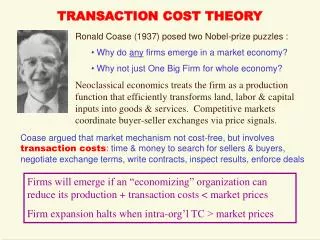
Transaction Cost Analysis • Total cost = production cost + transaction cost • Transaction costs ex ante: searching, drafting, negotiation • Transaction costs ex post: monitoring, enforcing agreements
Transaction Cost Analysis cont • High degree of asset specificity = highly specialised assets • Bounded rationality among us humans = as rational as possible within human limitations • Uncertainty in deliveries and technology • Bounded rationality -> incomplete contracts between buyer and supplier -> potential for opportunism (= seller misuse of power position)
Transaction cost Keep our business inhouse when: • High degree of asset specificity, • high degree of uncertainty, • few potential suppliers, • high risk for supplier uncertainty.
Outsourcing - the pros • Expansion without expanding the balance sheet • Time to market - TTM • Strategic flexibility • Better quality • Lower costs • Fight the NIH syndrome
The Outsourcing Trap Price Cost Price Cost Time
Outsourcing - the cons • Destroys core competence and complementary competence • Supplier power • Longer TTM and TTC • The supplier vs the end user • No internal restucturing • Too small value added