Download
1 / 34
340 likes | 451 Views
This study introduces an innovative method for retrieving sulfur dioxide (SO2) data from the upper troposphere and lower stratosphere using long-term TOVS measurements. The approach leverages HIRS channels to analyze SO2 and distinguish between different sources of SO2 emissions, such as fossil fuel combustion, biomass burning, and volcanic eruptions. The results demonstrate the capability for day/night global surveillance over more than 22 years, enhancing our understanding of atmospheric chemistry and climate impacts.

E N D
A New Method for the Retrieval of Upper Troposphere/Lower Stratosphere Sulfur Dioxide from Global Long-term TOVS Measurements Fred Prata, CSIRO Atmospheric Research, Australia John Bates, NOAA-ETL, USA Darren Jackson, NOAA-ETL, USA ITSC-XII Lorne, Victoria
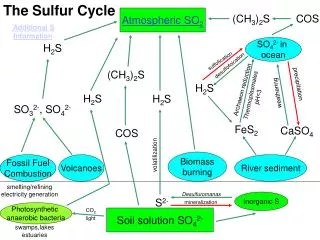
SO2 Budgets Source SO2 SO4 Fossil-fuel combustion +industry 70 2.2 Biomass burning 2.8 0.1 Oceans – 40–320 Plants+soils – 2–4 Volcanoes 7–8 2–4 Units: Tg(S) yr-1 Source: Berresheim et al. (1995) ITSC-XII Lorne, Victoria
The volcanic plume from Hekla on 29th of February ITSC-XII Lorne, Victoria
Infrared image (11 µm) x Encounter ITSC-XII Lorne, Victoria
Difference image (11-12 µm) x Encounter ITSC-XII Lorne, Victoria
7.3 µm image x Encounter ITSC-XII Lorne, Victoria
27 D.U. ITSC-XII Lorne, Victoria
24 D.U. TOMS SO2 (m atm-cm) 30 27 February, 2000 18 6 ITSC-XII Lorne, Victoria
MODIS channels and SO2 Line Strengths ITSC-XII Lorne, Victoria
SO2 line strengths Transmission Brightness temperature (t.o.a) Difference (Kelvin) ITSC-XII Lorne, Victoria
Weighting functions and transmission vs absorber amount ITSC-XII Lorne, Victoria
MODTRAN simulations ITSC-XII Lorne, Victoria
The Retrieval Scheme: • Get radiances for HIRS channels 8 (11.11 µm), 11 (7.34 µm) and 12 (6.76 µm) • Synthesise 7.3 µm channel from the 6.7 µm and 11.1 µm channels by linear interpolation in radiance • Compute difference DT=T*7.3-T7.3 (T* is the synthetic BT) • Exclude pixels with T11 < 220 K • Compute SO2 amount using model from RT simulations: • Log10[SO2]=c0+c1DT+c2DT2+c3DT3 ITSC-XII Lorne, Victoria
MODIS retrieval for Hekla, Feb 2000 eruption Approximate aircraft track ITSC-XII Lorne, Victoria
SOLVE (NASA DC-8) in situ SO2 measurements and MODIS retrievals show good agreement Integrated across plume: SOLVE=248 ppmV MODIS=241 ppmV ITSC-XII Lorne, Victoria
TOVS TOMS ITSC-XII Lorne, Victoria
TOVS TOMS ITSC-XII Lorne, Victoria
Eruption of Cerro Hudson, southern Chile 7-27 August, 1991 ITSC-XII Lorne, Victoria
Very cold scene temperatures (T<220 K) cause anomalies in retrieval scheme ITSC-XII Lorne, Victoria
Anomalies are removed by excluding pixels where T11< 220 K SO2 above very cold surfaces difficult to retrieve by this method ITSC-XII Lorne, Victoria
Different orbits give different mass loadings, but very similar mass densities NOAA-10-> 0.653 t km-2 (mass loading=0.98 Mt) NOAA-11-> 0.658 t km-2 (mass loading=0.33 Mt) NOAA-12-> 0.655 t km-2 (mass loading=0.86 Mt) ITSC-XII Lorne, Victoria
Mt St Helens, May, 1980 ITSC-XII Lorne, Victoria
Ash detection ITSC-XII Lorne, Victoria
SO2detection ITSC-XII Lorne, Victoria
Pinatubo 15 June - 15 July, 1991 ITSC-XII Lorne, Victoria
CONCLUSIONS • SO2 in the lower stratosphere and upper troposphere can be retrieved from the HIRS 7.3 µm channel • Day/night, global, long-term (>22 years) capability • Ozone/SO2 studies possible • Ash vs SO2 vs H2SO4 discrimination possible • Impact on humidity soundings using 7.3 µm channel • (RT models should consider SO2 absorption) • Climate applications - radiative effects using all TOVS channels ITSC-XII Lorne, Victoria
El Chichon, March 1982 ITSC-XII Lorne, Victoria











![[SO 2 + H 2 O H 2 SO 3 ] SO 3 + H 2 O H 2 SO 4 CO 2 +H 2 O H 2 CO 3](https://cdn2.slideserve.com/4275035/slide1-dt.jpg)