Download
1 / 8
80 likes | 200 Views
Delve into the advantages and disadvantages of observing from space, importance of the full electromagnetic spectrum, and the unique perspective space observation offers. Learn about the characteristics of light and the implications of observing beyond Earth's atmosphere.

E N D
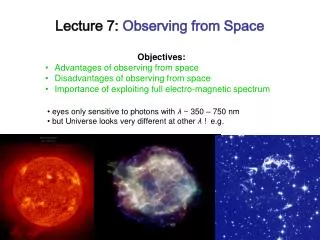
Lecture 7: Observing from Space • eyes only sensitive to photons with λ ~ 350 – 750 nm • but Universe looks very different at other λ ! e.g. Objectives: Advantages of observing from space Disadvantages of observing from space Importance of exploiting full electro-magnetic spectrum PHYS1005 – 2003/4
Electro-Magnetic Spectrum • Light has: • wave-like properties λע = c • particle-like properties (photons, E = hע) • usually measure photon E in electron-volts (eV) • (1eV = 1.6 x 10⁻¹⁹ J = E to raise one electron through 1V potential) • e.g. takes 13.6eV to ionise H (from its ground state) • photons with E > 13.6eV strongly absorbed by interstellar gas • Galaxy almost opaque for λ just below 91 nm PHYS1005 – 2003/4
Advantages of Observing from Space: • No atmospheric absorption • No image motions (“seeing” or blurring) • No sunlit sky or “weather” • Lower sky background • air glows ≡ one 22nd mag star per square arcsec • less (but not 0) in space (why?) detect fainter stars • especially important in IR (at 10μ everything glows at T = 300K like observing with the lights on!) • No atmospheric refraction (bending) of light • light bent by refraction by 0.5o at horizon! • limits positional astronomy for parallaxes • Can get closer to target (solar system only!) • No mechanical vibration (essential for gravity wave expt) • Avoid terrestrial interference (radio) Additional reading: Kaufmann (Chap. 5), Zeilik (Chap. 9) PHYS1005 – 2003/4
Disadvantages of Observing from Space: • Expense! Hugely expensive e.g. HST ≈ £2B, 8m VLT ≈ £0.1B! • Radiation background. High (particle and radiation) background damages detectors, causes spurious events. • Maintenance. Difficult, dangerous, expensive, sometimes impossible. e.g. HST, JWST • Long development time. Space equipment often out-dated by time of launch. e.g. original HST • Risk! Things can go horribly wrong! e.g. CLUSTER, Challenger, Columbia. PHYS1005 – 2003/4
1) Atmospheric absorption effects: • Earth’s atmosphere allows a few spectral windows (optical, IR, radio) Note loss of UV, X, γ-ray (λ < 320 nm) and far-IR (>10μ) PHYS1005 – 2003/4
2) Atmospheric Motions (“Seeing”) • seeing limits resolution to ~ 0.3 – 1 arcsec • cf diffraction limit for VLT 8m at λ ~ 500nm is 0.016 arcsec! • development of HST • N.B. higher angular resolution can detect fainter stars! • e.g. HST has reached close to V = 30 PHYS1005 – 2003/4
3) No sunlit sky or weather • no air to scatter sunlight can observe in “daytime” • can observe for » 8 hours (e.g. Chandra) • no clouds but beware: PHYS1005 – 2003/4